


Next: Degenerate Perturbation Theory
Up: Time-Independent Perturbation Theory
Previous: Non-Degenerate Perturbation Theory
Quadratic Stark Effect
Suppose that a one-electron atom [i.e., either a hydrogen atom, or an alkali metal
atom (which possesses one valance electron orbiting outside a closed, spherically
symmetric, shell)] is subjected to a uniform electric field in the positive
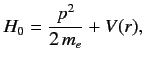
 -direction. The Hamiltonian of the system can be split into two
parts. The unperturbed Hamiltonian,
-direction. The Hamiltonian of the system can be split into two
parts. The unperturbed Hamiltonian,
 |
(617) |
and the perturbing Hamiltonian,
 |
(618) |
Here, we are neglecting the small difference between the reduced mass,  , and the electron mass,
  .
.
It is assumed that the unperturbed energy eigenvalues and eigenstates are completely
known. The electron spin is irrelevant in this problem (because the spin operators
all commute with  ), so we can ignore the spin degrees of freedom of the system.
This implies that the system possesses no degenerate energy eigenvalues. Actually, this is
not true for the
), so we can ignore the spin degrees of freedom of the system.
This implies that the system possesses no degenerate energy eigenvalues. Actually, this is
not true for the  energy levels of the hydrogen atom, due to the special
properties of a pure Coulomb potential.
It is necessary to deal with this case separately, because
the perturbation theory presented in Section 7.3 breaks down for degenerate
unperturbed energy levels.
energy levels of the hydrogen atom, due to the special
properties of a pure Coulomb potential.
It is necessary to deal with this case separately, because
the perturbation theory presented in Section 7.3 breaks down for degenerate
unperturbed energy levels.
An energy eigenket of the unperturbed Hamiltonian is characterized by three quantum numbers--the radial quantum number  , and the two angular quantum numbers
  and
and
 (see Section 4.6). Let us denote such a ket
 , and let its
energy be
, and let its
energy be  . According to Equation (614), the change in this
energy induced by a small electric field is given by
. According to Equation (614), the change in this
energy induced by a small electric field is given by
 |
(619) |
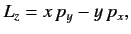
Now, since
 |
(620) |
it follows that
![$\displaystyle [L_z, z] = 0.$](img1500.png) |
(621) |
Thus,
![$\displaystyle \langle n,l, m\vert\, [L_z, z]\, \vert n',l',m'\rangle = 0,$](img1501.png) |
(622) |
giving
 |
(623) |
because
is, by definition, an eigenstate of  with eigenvalue
 . It is clear, from the above relation, that
the matrix element
. It is clear, from the above relation, that
the matrix element
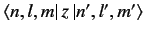 is zero unless
  .
This is termed the selection rule for the quantum number
.
.
This is termed the selection rule for the quantum number
.
Let us now determine the selection rule for
. We have
where use has been made of Equations (290)-(295).
Similarly,
Thus,
This reduces to
![$\displaystyle [L^2, [L^2, z]] = - \hbar^2 \left[4\,(L_x\, x + L_y \,y + L_z \,z...
...- 4\, (L_x^{\,2} + L_y^{\,2} + L_z^{\,2})\, z + 2 \,(L^2\, z - z\, L^2)\right].$](img1516.png) |
(628) |
However, it is clear from Equations (290)-(292) that
 |
(629) |
Hence, we obtain
![$\displaystyle [L^2, [L^2, z]] = 2 \,\hbar^2\, (L^2\, z + z \,L^2),$](img1518.png) |
(630) |
which can be expanded to give
 |
(631) |
Equation (631) implies that
 |
(632) |
This expression yields
![$\displaystyle \left[l^{\,2}\, (l+1)^2 - 2\, l\,(l+1)\,l'\,(l'+1) + l'^{\,2}\,(l...
...(l+1) - 2\,l'\,(l'+1)\right] \langle n,l,m\vert\,z\,\vert n',l',m' \rangle = 0,$](img1521.png) |
(633) |
which reduces to
 |
(634) |
According to the above formula, the matrix element
vanishes unless  or
or
 . This matrix element can be written
 |
(635) |
where
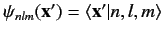 . Recall, however,
that the wavefunction of an
. Recall, however,
that the wavefunction of an  state is spherically symmetric (see Section 4.3):
i.e.,
state is spherically symmetric (see Section 4.3):
i.e.,
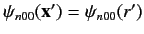 . It follows from Equation (635)
that the matrix element
vanishes by symmetry when
. In conclusion, the matrix element
is zero unless
. This is
the selection rule for the quantum number
.
. It follows from Equation (635)
that the matrix element
vanishes by symmetry when
. In conclusion, the matrix element
is zero unless
. This is
the selection rule for the quantum number
.
Application of the selection rules to Equation (619) yields
 |
(636) |
Note that all of the terms in Equation (619) that vary linearly with
the electric field-strength
vanish by symmetry, according to the selection rules.
Only those terms that vary quadratically with the
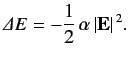
field-strength survive. The electrical polarizability,  , of an atom is defined in terms
of the electric-field induced energy-shift of a given atomic state as follows:
, of an atom is defined in terms
of the electric-field induced energy-shift of a given atomic state as follows:
 |
(637) |
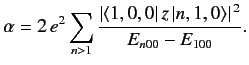
Consider the ground state of a hydrogen atom. (Recall, that we cannot address
the  excited states because they are degenerate, and our theory cannot
handle this at present). The polarizability of this state is given by
excited states because they are degenerate, and our theory cannot
handle this at present). The polarizability of this state is given by
 |
(638) |
Here, we have made use of the fact that
 for a hydrogen atom.
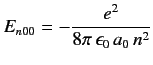
The sum in the above expression can be evaluated approximately by noting that
[see Equation (409)]
 |
(639) |
for a hydrogen atom,
where
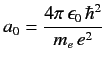 |
(640) |
is the Bohr radius. We can write
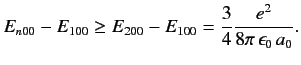 |
(641) |
Thus,
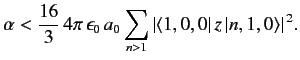 |
(642) |
However,
 |
(643) |
where we have made use of the fact that the wavefunctions of a hydrogen atom
form a complete set. It is easily demonstrated from the
actual form of the ground-state wavefunction
that
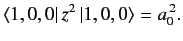 |
(644) |
Thus, we conclude that
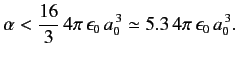 |
(645) |
The exact result is
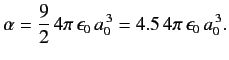 |
(646) |
It is possible to obtain this result, without recourse to perturbation
theory, by solving Schrödinger's equation in parabolic coordinates.
Next: Degenerate Perturbation Theory
Up: Time-Independent Perturbation Theory
Previous: Non-Degenerate Perturbation Theory
Richard Fitzpatrick
2013-04-08
![$\displaystyle [L^2, z]$](img1505.png)
![$\displaystyle = [L_x^{\,2}, z] + [L_y^{\,2}, z] = L_x\,[L_x, z] + [L_x, z] \,L_x + L_y\,[L_y, z] + [L_y, z]\, L_y$](img1506.png)


![$\displaystyle [L^2, y]$](img1509.png)
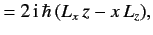
![$\displaystyle [L^2, x]$](img1511.png)
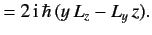
![$\displaystyle [L^2, [L^2, z]]$](img1513.png)
![$\displaystyle = 2 \,{\rm i} \, \hbar \left( L^2, L_y \,x - L_x\, y + {\rm i}\,\...
...hbar \left( L_y\, [L^2, x] - L_x\, [ L^2, y] + {\rm i}\,\hbar\, [L^2, z]\right)$](img1514.png)
