


 and their conjugate momenta
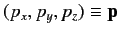 . The classical
definition of the orbital angular momentum of such a particle about the
origin is
. The classical
definition of the orbital angular momentum of such a particle about the
origin is
 , giving
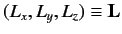 which
represent the components of
orbital angular momentum in quantum mechanics can be defined in
an analogous manner to the corresponding components of
classical angular momentum. In other words, we are
going to assume that the above equations specify the angular momentum operators
in terms of the position and linear momentum operators. Note that
which
represent the components of
orbital angular momentum in quantum mechanics can be defined in
an analogous manner to the corresponding components of
classical angular momentum. In other words, we are
going to assume that the above equations specify the angular momentum operators
in terms of the position and linear momentum operators. Note that  ,
,  ,
and
,
and  are Hermitian, so they represent things which can, in principle,
be measured. Note, also, that there is no ambiguity regarding the order
in which operators appear in products on the right-hand sides of Equations (290)-(292),
because all of the products consist of operators that commute.
are Hermitian, so they represent things which can, in principle,
be measured. Note, also, that there is no ambiguity regarding the order
in which operators appear in products on the right-hand sides of Equations (290)-(292),
because all of the products consist of operators that commute.
The fundamental commutation relations satisfied by the position and linear momentum operators are [see Equations (114)-(116)]
 and
and  stand for either
  ,
,  , or
, or  .
Consider the commutator of the operators
and
:
.
Consider the commutator of the operators
and
:
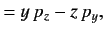
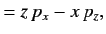
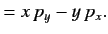
![$\displaystyle [L_x, L_y]$](img742.png) |
![$\displaystyle = [(y\,p_z-z\,p_y), (z\,p_x-x \,p_z)] = y\,[p_z, z]\,p_x + x\,p_y\,[z, p_z]$](img743.png) |
|
 |
(296) |
Suppose that there are  particles in the system, with
angular momentum vectors
particles in the system, with
angular momentum vectors  (where
runs from 1 to
).
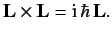
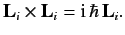
Each of these vectors satisfies Equation (300), so that
(where
runs from 1 to
).
Each of these vectors satisfies Equation (300), so that
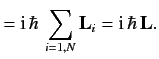
 . Consider the total angular momentum of the system,
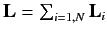 . It is clear from Equations (301) and (302)
that
. It is clear from Equations (301) and (302)
that
The immediate conclusion which can be drawn from the commutation relations
(297)-(299) is that the three components of an angular momentum vector cannot
be specified (or measured) simultaneously. In fact, once we have specified one
component, the values of other two components become uncertain. It is
conventional to specify the
-component,
.
Consider the magnitude squared of the angular momentum vector,
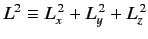 . The commutator of
  and
is
written
and
is
written
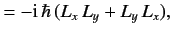
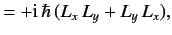
![$\displaystyle [L^2, L_z] = [L_x^{\,2}, L_z] + [L_y^{\,2}, L_z] + [L_z^{\,2}, L_z].$](img761.png) |
(304) |
![$\displaystyle [L_x^{\,2}, L_z]$](img762.png) |
 |
(305) |
![$\displaystyle [L_y^{\,2}, L_z]$](img764.png) |
 |
(306) |
![$\displaystyle [L_z^{\,2}, L_z]$](img766.png) |
 |
(307) |
-direction, we conclude that
also
commutes with
and
. It is clear from Equations (297)-(299) and
(308) that the best we
can do in quantum mechanics is to specify the
magnitude of an angular momentum vector
along with one of its components (by convention, the
-component).
It is convenient to define the shift operators  and
and  :
:
 |
 |
(309) |
 |
 |
(310) |
![$\displaystyle [L^+, L_z ]$](img774.png) |
 |
(311) |
![$\displaystyle [L^-, L_z]$](img776.png) |
 |
(312) |
![$\displaystyle [L^+, L^-]$](img778.png) |
 |
(313) |
.



![$\displaystyle [x_i, x_j]$](img738.png)
![$\displaystyle [p_i, p_j]$](img294.png)
![$\displaystyle [x_i, p_j]$](img739.png)


![$\displaystyle [L_y, L_z]$](img746.png)

![$\displaystyle [L_z, L_x]$](img748.png)




![$\displaystyle [L^2, L_z] = 0.$](img767.png)