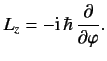
. The classical momentum conjugate to the azimuthal
angle
. The classical momentum conjugate to the azimuthal
angle  is the
  -component of angular momentum,
  .
According to Section 2.5, in quantum mechanics we can always adopt the Schrödinger
representation, for which ket space is spanned by the simultaneous eigenkets
of the position operators
.
According to Section 2.5, in quantum mechanics we can always adopt the Schrödinger
representation, for which ket space is spanned by the simultaneous eigenkets
of the position operators  ,
,  , and
, and
takes the
form
, and
, and
takes the
form
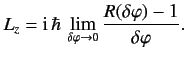
Consider an operator
 that rotates the system through an angle
 about the
-axis. This operator is very similar to the
operator
about the
-axis. This operator is very similar to the
operator
 , introduced in Section 2.8, which translates the system
a distance
, introduced in Section 2.8, which translates the system
a distance
 along the
  -axis.
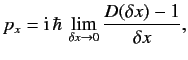
We were able to demonstrate in Section 2.8
that
-axis.
We were able to demonstrate in Section 2.8
that
 |
(347) |
 is the linear momentum conjugate to
. There is nothing
in our derivation of this result which specifies that
has to be a Cartesian
coordinate. Thus, the result should apply just as well to an angular
coordinate. We conclude that
is the linear momentum conjugate to
. There is nothing
in our derivation of this result which specifies that
has to be a Cartesian
coordinate. Thus, the result should apply just as well to an angular
coordinate. We conclude that
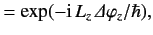
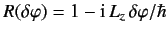
According to Equation (348), we can write
 |
(349) |
 . In other words, the angular momentum
operator
can be used to rotate the system about the
-axis by an infinitesimal amount.
We say that
is the generator of rotations about the
-axis.
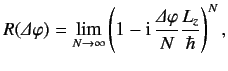
The above equation implies that
. In other words, the angular momentum
operator
can be used to rotate the system about the
-axis by an infinitesimal amount.
We say that
is the generator of rotations about the
-axis.
The above equation implies that
 |
(350) |
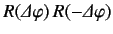
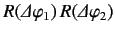
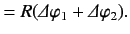
has all of the properties we would expect of
a rotation operator: i.e.,
 |
 |
(352) |
 |
|
(353) |
 |
 |
(354) |
Suppose that the system is in a simultaneous eigenstate of  and
.
As before, this state is represented by the eigenket
and
.
As before, this state is represented by the eigenket
 , where
the eigenvalue of
is
, where
the eigenvalue of
is
 , and
the eigenvalue of
is
, and
the eigenvalue of
is  . We expect the wavefunction
to remain unaltered if we rotate
the system
. We expect the wavefunction
to remain unaltered if we rotate
the system  degrees about the
-axis. Thus,
degrees about the
-axis. Thus,
 |
(355) |
 must be an integer. This implies, from the previous
section, that
must be an integer. This implies, from the previous
section, that  must also be an integer. Thus, an orbital angular momentum
can only take integer values of the quantum numbers
and
.
must also be an integer. Thus, an orbital angular momentum
can only take integer values of the quantum numbers
and
.
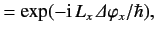
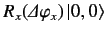
Consider the action of the rotation operator
on an eigenstate
possessing zero angular momentum about the
-axis (i.e., an  state). We have
 |
(356) |
-axis. Clearly,
its wavefunction must be symmetric about the
-axis.
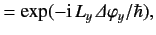
There is nothing special about the
-axis, so we can write
 denotes an operator
that rotates the system by an angle
denotes an operator
that rotates the system by an angle
 about the
-axis, etc.
Suppose that the system is in an eigenstate of zero overall orbital angular momentum
(i.e., an
about the
-axis, etc.
Suppose that the system is in an eigenstate of zero overall orbital angular momentum
(i.e., an  state).
We know that the system is also in an eigenstate of zero orbital angular momentum
about any particular axis. This follows because
implies
, according
to the
previous section, and we can choose the
-axis to point in any direction.
Thus,
state).
We know that the system is also in an eigenstate of zero orbital angular momentum
about any particular axis. This follows because
implies
, according
to the
previous section, and we can choose the
-axis to point in any direction.
Thus,
 |
 |
(360) |
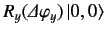 |
|
(361) |
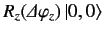 |
 |
(362) |
Note that a rotation about the
-axis does not commute with a rotation
about the  -axis. In other words, if the system is rotated an angle
about the
-axis, and then
-axis. In other words, if the system is rotated an angle
about the
-axis, and then
 about the
-axis, it ends up in a different state to that obtained by rotating
an angle
about the
-axis, and then
about the
-axis. In quantum
mechanics, this implies that
about the
-axis, it ends up in a different state to that obtained by rotating
an angle
about the
-axis, and then
about the
-axis. In quantum
mechanics, this implies that
 , or
, or
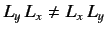 , [see Equations (357)-(359)]. Thus, the noncommuting
nature of the angular momentum operators is a direct consequence
of the fact that
rotations do not commute.
, [see Equations (357)-(359)]. Thus, the noncommuting
nature of the angular momentum operators is a direct consequence
of the fact that
rotations do not commute.