


Next: Motion in Central Field
Up: Orbital Angular Momentum
Previous: Rotation Operators
Eigenfunctions of Orbital Angular Momentum
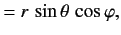
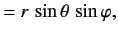
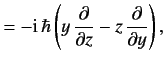
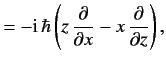
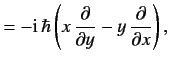
In Cartesian coordinates, the three components of orbital angular
momentum can be written
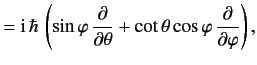
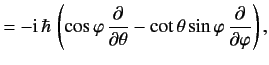
using the Schrödinger representation. Transforming to standard
spherical polar coordinates,
we obtain
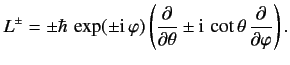
Note that Equation (371) accords with Equation (346). The shift
operators
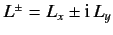 become
 |
(372) |
Now,
 |
(373) |
so
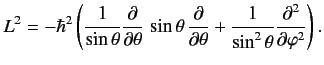 |
(374) |
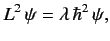
The eigenvalue problem for
 takes the form
 |
(375) |
where
 is the wavefunction, and
  is a number.
Let us write
is a number.
Let us write
 |
(376) |
Equation (375) reduces to
 |
(377) |
where use has been made of Equation (374). As is well-known,
square integrable solutions to this
equation only exist when
takes the values  , where
  is
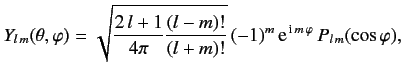
an integer. These solutions are known as spherical harmonics, and
can be written
is
an integer. These solutions are known as spherical harmonics, and
can be written
 |
(378) |
where  is a positive integer lying in the range
 . Here,
 is an associated Legendre function satisfying the
equation
is an associated Legendre function satisfying the
equation
![$\displaystyle \frac{d}{d\xi}\! \left[ (1-\xi^{\,2})\,\frac{dP_{l\,m}}{d\xi}\right] - \frac{m^2}{1-\xi^{\,2}}\, P_{l\,m} + l\,(l+1)\,P_{l\,m} = 0.$](img909.png) |
(379) |
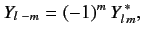
We define
 |
(380) |
which allows
to take the negative values
 .
The spherical harmonics are orthogonal functions, and are
properly normalized with respect to integration over
the entire solid angle:
.
The spherical harmonics are orthogonal functions, and are
properly normalized with respect to integration over
the entire solid angle:
 |
(381) |
The spherical harmonics also form a complete set for representing general functions
of  and
and  .
.
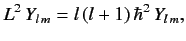
By definition,
 |
(382) |
where
is an integer.
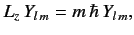
It follows from Equations (371) and (378) that
 |
(383) |
where
is an integer lying in the range
 . Thus, the
wavefunction
. Thus, the
wavefunction
 , where
 is a general function, has
all of the expected features of the wavefunction
of a simultaneous eigenstate of
and
is a general function, has
all of the expected features of the wavefunction
of a simultaneous eigenstate of
and  belonging to the quantum numbers
and
. The well-known formula
belonging to the quantum numbers
and
. The well-known formula
 |
(384) |
can be combined with Equations (372) and (378) to give
These equations are equivalent to Equations (344)-(345). Note that a spherical
harmonic wavefunction
is symmetric about the  -axis (i.e., independent of
) whenever
-axis (i.e., independent of
) whenever
 , and is spherically symmetric whenever
  (since
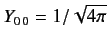 ).
).
In summary, by solving directly
for the
eigenfunctions of
and
in the Schrödinger representation, we have been able to reproduce
all of the results of Section 4.2. Nevertheless, the results of Section 4.2
are more general than those obtained in this section, because they still apply
when the quantum number
takes on half-integer values.
Next: Motion in Central Field
Up: Orbital Angular Momentum
Previous: Rotation Operators
Richard Fitzpatrick
2013-04-08








![$\displaystyle = [l\,(l+1)- m\,(m+1)]^{1/2}\,\hbar\,Y_{l\,\,m+1},$](img919.png)

![$\displaystyle = [l\,(l+1) - m \,(m-1)]^{1/2} \,\hbar \,Y_{l\,\,m-1}.$](img921.png)