


 and linear momentum
 is defined as
 and
and  (where
  ,
,  ,
,  , etc.)
correspond to the appropriate quantum mechanical position and momentum operators. The first point to note is that expressions (527)-(529) are unambiguous with respect to the order of the terms in multiplicative factors, since the various position and momentum operators
appearing in them all commute
with one another [see Eqs. (483)]. Moreover, given that the and
the are Hermitian operators, it is easily seen that the
, etc.)
correspond to the appropriate quantum mechanical position and momentum operators. The first point to note is that expressions (527)-(529) are unambiguous with respect to the order of the terms in multiplicative factors, since the various position and momentum operators
appearing in them all commute
with one another [see Eqs. (483)]. Moreover, given that the and
the are Hermitian operators, it is easily seen that the  are
also Hermitian. This is important, since only Hermitian operators can represent physical variables in quantum mechanics (see Sect. 4.6).
We, thus, conclude that Eqs. (527)-(529) are plausible
definitions for the quantum mechanical operators which represent the components of angular momentum.
are
also Hermitian. This is important, since only Hermitian operators can represent physical variables in quantum mechanics (see Sect. 4.6).
We, thus, conclude that Eqs. (527)-(529) are plausible
definitions for the quantum mechanical operators which represent the components of angular momentum.
Let us now derive the commutation relations for the .
For instance,
![$\displaystyle [L_x, L_y]$](img1315.png) |
 |
![$\displaystyle [y p_z-z p_y, z p_x-x p_z] = y p_x [p_z,z] + x p_y [z,p_z]$](img1316.png) |
|
|
 |
(530) |
[see Eqs. (527)-(529)], and commutation relations (481)-(483)
for the and . There are two similar commutation relations:
one for  and
and  , and one for and
  . Collecting all of these
commutation relations together, we obtain
. Collecting all of these
commutation relations together, we obtain
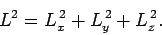
By analogy with classical mechanics, the operator  , which represents
the magnitude squared of the angular momentum vector, is defined
, which represents
the magnitude squared of the angular momentum vector, is defined
 and
and  are two general
operators then
are two general
operators then
![$\displaystyle [L^2,L_x]$](img1327.png) |
|
![$\displaystyle [L_y^{ 2},L_x] + [L_z^{ 2},L_x]$](img1328.png) |
|
|
![$\displaystyle L_y [L_y,L_x] + [L_y,L_x] L_y + L_z [L_z,L_x] + [L_z, L_x] L_z$](img1329.png) |
||
|
 |
(536) |
commutes with . Likewise, it is easily demonstrated that
also commutes with , and with . Thus,
Recall, from Sect. 4.10, that in order for two physical quantities
to be (exactly) measured simultaneously, the operators which represent
them in quantum mechanics must commute with one another. Hence,
the commutation relations (531)-(533) and (537)
imply that we can only simultaneously measure the magnitude squared of
the angular momentum vector, , together with, at most, one of its
Cartesian components. By convention, we shall always choose to measure
the  -component, .
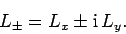
Finally, it is helpful to define the operators
 and
and  are not Hermitian operators, but are
the Hermitian conjugates of one another (see Sect. 4.6): i.e.,
are not Hermitian operators, but are
the Hermitian conjugates of one another (see Sect. 4.6): i.e.,
![\begin{displaymath}[L_+, L_-]= 2 \hbar L_z.
\end{displaymath}](img1340.png) |
(542) |
![\begin{displaymath}[L_-,L_z]= \hbar L_-.
\end{displaymath}](img1343.png) |
(544) |


![$\displaystyle [L_y, L_z]$](img1321.png)

![$\displaystyle [L_z,L_x]$](img1323.png)

![\begin{displaymath}[A^2,B]= A [A, B] +[A,B] A.
\end{displaymath}](img1326.png)
![\begin{displaymath}[L^2, L_x]= [L^2, L_y] = [L^2,L_z] = 0.
\end{displaymath}](img1331.png)
![\begin{displaymath}
(L_\pm)^\dag = L_\mp,\ [0.5ex]
\end{displaymath}](img1335.png)

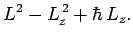
![$\displaystyle (L_x+{\rm i} L_y) (L_x-{\rm i} L_y)
= L_x^{ 2} + L_y^{ 2} - {\rm i} [L_x, L_y]
= L_x^{ 2} + L_y^{ 2} + \hbar L_z$](img1337.png)

![$\displaystyle [L_+,L_z]$](img1341.png)
![$\displaystyle [L_x,L_z] + {\rm i} [L_y,L_z] = -{\rm i} \hbar L_y - \hbar L_x= - \hbar L_+,$](img1342.png)