next up previous contents
Next: Eigenvalues of Up: Orbital angular momentum Previous: Representation of angular momentum   Contents


Eigenstates of angular momentum

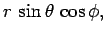
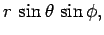
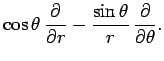
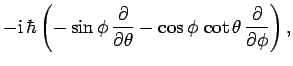
Let us find the simultaneous eigenstates of the angular momentum operators $L_z$ and $L^2$. Since both of these operators can be represented as purely angular differential operators, it stands to reason that their eigenstates only depend on the angular coordinates $\theta $ and $\phi$. Thus, we can write
$\displaystyle L_z\,Y_{l,m}(\theta,\phi)$ $\textstyle =$ $\displaystyle m\,\hbar\,Y_{l,m}(\theta,\phi),$ (535)
$\displaystyle L^2\,Y_{l,m}(\theta,\phi)$ $\textstyle =$ $\displaystyle l\,(l+1)\,\hbar^{\,2}\,Y_{l,m}(\theta,\phi).$ (536)

Here, the $Y_{l,m}(\theta,\phi)$ are the eigenstates in question, whereas the dimensionless quantities $m$ and $l$ parameterize the eigenvalues of $L_z$ and $L^2$, which are $m\,\hbar$ and $l\,(l+1)\,\hbar^2$, respectively. Of course, we expect the $Y_{l,m}$ to be both mutually orthogonal and properly normalized (see Sect. 4.9), so that
\begin{displaymath}
\oint Y^{\,\ast}_{l',m'}(\theta,\phi)\,Y_{l,m}(\theta,\phi)\,d\Omega = \delta_{ll'}\,\delta_{mm'},
\end{displaymath} (537)

where $d\Omega = \sin\theta\,d\theta\,d\phi$ is an element of solid angle, and the integral is over all solid angle.

Now,

$\displaystyle L_z\,(L_+\,Y_{l,m})$ $\textstyle =$ $\displaystyle (L_+\,L_z + [L_z, L_+])\,Y_{l,m}= (L_+\,L_z + \hbar\,L_+)\,Y_{l,m}$  
  $\textstyle =$ $\displaystyle (m+1)\,\hbar\,(L_+\,Y_{l,m}),$ (538)

where use has been made of Eq. (525). We, thus, conclude that when the operator $L_+$ operates on an eigenstate of $L_z$ corresponding to the eigenvalue $m\,\hbar$ it converts it to an eigenstate corresponding to the eigenvalue $(m+1)\,\hbar$. Hence, $L_+$ is known as the raising operator (for $L_z$). It is also easily demonstrated that
\begin{displaymath}
L_z\,(L_-\,Y_{l,m}) = (m-1)\,\hbar\,(L_-\,Y_{l,m}).
\end{displaymath} (539)

In other words, when $L_-$ operates on an eigenstate of $L_z$ corresponding to the eigenvalue $m\,\hbar$ it converts it to an eigenstate corresponding to the eigenvalue $(m-1)\,\hbar$. Hence, $L_-$ is known as the lowering operator (for $L_z$).

Writing

$\displaystyle L_+\,Y_{l,m}$ $\textstyle =$ $\displaystyle c_{l,m}^+\,Y_{l,m+1},$ (540)
$\displaystyle L_-\,Y_{l,m}$ $\textstyle =$ $\displaystyle c_{l,m}^-\,Y_{l,m-1},$ (541)

we obtain
\begin{displaymath}
L_-\,L_+\,Y_{l,m} = c^+_{l,m}\,c^-_{l,m+1}\,Y_{l,m} =
[l\,(l+1)-m\,(m+1)]\,\hbar^2\,Y_{l,m},
\end{displaymath} (542)

where use has been made of Eq. (523). Likewise,
\begin{displaymath}
L_+\,L_-\,Y_{l,m} = c^+_{l,m-1}\,c^-_{l,m}\,Y_{l,m} = [l\,(l+1)-m\,(m-1)]\,\hbar^2\,Y_{l,m},
\end{displaymath} (543)

where use has been made of Eq. (522). It follows that
$\displaystyle c^+_{l,m}\,c^-_{l,m+1}$ $\textstyle =$ $\displaystyle [l\,(l+1)-m\,(m+1)]\,\hbar^2,$ (544)
$\displaystyle c^+_{l,m-1}\,c^-_{l,m}$ $\textstyle =$ $\displaystyle [l\,(l+1)-m\,(m-1)]\,\hbar^2.$ (545)

These equations are satisfied when
\begin{displaymath}
c^\pm_{l,m} = [l\,(l+l) - m\,(m\pm 1)]^{1/2}\,\hbar.
\end{displaymath} (546)

Hence, we can write
$\displaystyle L_+\,Y_{l,m}$ $\textstyle =$ $\displaystyle [l\,(l+1)-m\,(m+1)]^{1/2}\,\hbar\,Y_{l,m+1},$ (547)
$\displaystyle L_-\,Y_{l,m}$ $\textstyle =$ $\displaystyle [l\,(l+1)-m\,(m-1)]^{1/2}\,\hbar\,Y_{l,m-1}.$ (548)


next up previous contents
Next: Eigenvalues of Up: Orbital angular momentum Previous: Representation of angular momentum   Contents
Richard Fitzpatrick 2006-12-12