


Next: Two-State System
Up: Time-Independent Perturbation Theory
Previous: Introduction
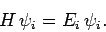
Before commencing our investigation, it is helpful to introduce some
improved notation. Let the  be a complete set of eigenstates
of the Hamiltonian,
be a complete set of eigenstates
of the Hamiltonian,  , corresponding to the eigenvalues
  :
i.e.,
:
i.e.,
 |
(855) |
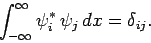
Now, we expect the to be orthonormal (see Sect. 4.9).
In one dimension, this implies that
 |
(856) |
In three dimensions (see Cha. 7), the above expression generalizes to
 |
(857) |
Finally, if the are spinors (see Cha. 10) then
we have
 |
(858) |
The generalization to the case where  is a product of a regular
wavefunction and a spinor is fairly obvious. We can represent all
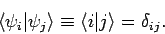
of the above possibilities by writing
is a product of a regular
wavefunction and a spinor is fairly obvious. We can represent all
of the above possibilities by writing
 |
(859) |
Here, the term in angle brackets represents the integrals in Eqs. (856)
and (857) in one- and three-dimensional regular space, respectively,
and the spinor product (858) in spin-space. The advantage of
our new notation is its great generality: i.e., it
can deal with one-dimensional wavefunctions, three-dimensional wavefunctions,
spinors, etc.
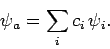
Expanding a general wavefunction,  , in terms of the energy
eigenstates, , we obtain
, in terms of the energy
eigenstates, , we obtain
 |
(860) |
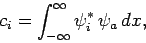
In one dimension, the expansion coefficients take the form (see Sect. 4.9)
 |
(861) |
whereas in three dimensions we get
 |
(862) |
Finally, if is a spinor then we have
 |
(863) |
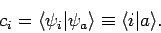
We can represent all of the above possibilities by
writing
 |
(864) |
The expansion (860) thus becomes
 |
(865) |
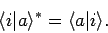
Incidentally, it follows that
 |
(866) |
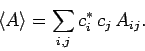
Finally, if  is a general operator, and the wavefunction
is expanded in the manner shown in Eq. (860), then the expectation value of
is written (see Sect. 4.9)
is a general operator, and the wavefunction
is expanded in the manner shown in Eq. (860), then the expectation value of
is written (see Sect. 4.9)
 |
(867) |
Here, the  are unsurprisingly known as the matrix
elements of .
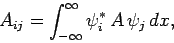
In one dimension, the matrix elements take the form
are unsurprisingly known as the matrix
elements of .
In one dimension, the matrix elements take the form
 |
(868) |
whereas in three dimensions we get
 |
(869) |
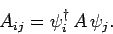
Finally, if is a spinor then we have
 |
(870) |
We can represent all of the above possibilities by
writing
 |
(871) |
The expansion (867) thus becomes
 |
(872) |
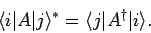
Incidentally, it follows that [see Eq. (194)]
 |
(873) |
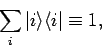
Finally, it is clear from Eq. (872) that
 |
(874) |
where the are a complete set of eigenstates, and 1 is the
identity operator.
Next: Two-State System
Up: Time-Independent Perturbation Theory
Previous: Introduction
Richard Fitzpatrick
2010-07-20