


 |
(854) |
 is a simple Hamiltonian whose eigenvalues and eigenstates
are known exactly.
is a simple Hamiltonian whose eigenvalues and eigenstates
are known exactly.  introduces some interesting additional
physics into the problem, but is sufficiently complicated that when
we add it to we can no longer find the exact energy eigenvalues
and eigenstates. However, can, in some sense (which we shall
specify more precisely later on), be regarded as being small compared
to . Can we find approximate eigenvalues and eigenstates
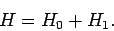
of the modified Hamiltonian,
introduces some interesting additional
physics into the problem, but is sufficiently complicated that when
we add it to we can no longer find the exact energy eigenvalues
and eigenstates. However, can, in some sense (which we shall
specify more precisely later on), be regarded as being small compared
to . Can we find approximate eigenvalues and eigenstates
of the modified Hamiltonian,  , by performing some
sort of perturbation expansion about the eigenvalues and eigenstates of the original
Hamiltonian, ? Let us investigate.
, by performing some
sort of perturbation expansion about the eigenvalues and eigenstates of the original
Hamiltonian, ? Let us investigate.
Incidentally, in this chapter, we shall only discuss so-called time-independent
perturbation theory, in which the modification to the Hamiltonian,
, has no explicit dependence on time. It is also assumed
that the unperturbed Hamiltonian, , is time-independent.