


Next: Solar Wind Up: Magnetohydrodynamic Fluids Previous: Flux Freezing Contents
 |
 |
(8.22) |
 |
 |
(8.23) |
 |
|
(8.24) |
 |
 |
(8.25) |
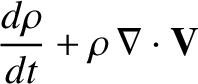
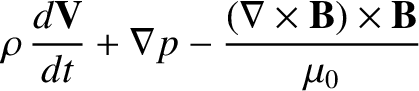
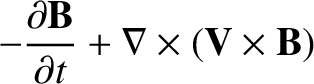
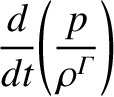
 ,
,  , and
, and  are
constants in a spatially uniform plasma.
are
constants in a spatially uniform plasma.
Let us search for wave-like solutions to Equations (8.26)–(8.29) in which perturbed
quantities vary like
![$\exp[\,{\rm i}\,({\bf k}\cdot{\bf r}-\omega\,t)]$](img1871.png) .
It follows that
.
It follows that
 |
|
(8.30) |
 |
|
(8.31) |
 |
|
(8.32) |
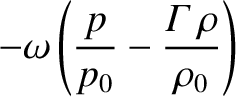 |
|
(8.33) |
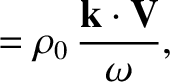
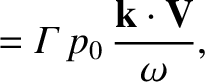
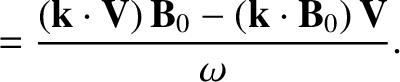
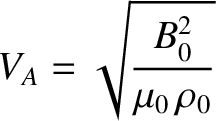
 , the previous equations yield
Substitution of these expressions into the linearized equation of
motion, Equation (8.31), gives
, the previous equations yield
Substitution of these expressions into the linearized equation of
motion, Equation (8.31), gives
We can assume, without loss of generality, that the equilibrium magnetic
field, ,
is directed along the  -axis, and that the wavevector,
  , lies
in the
, lies
in the  - plane. Let
  be the angle subtended between and
. Equation (8.37) reduces to the eigenvalue
equation
be the angle subtended between and
. Equation (8.37) reduces to the eigenvalue
equation
There are three independent roots of the previous dispersion relation, corresponding to the three different types of wave that can propagate through an MHD plasma. The first, and most obvious, root is
which has the associated eigenvector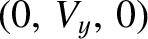 . This
root is characterized by both
. This
root is characterized by both
 and
and
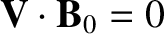 . It immediately follows from Equations (8.34) and (8.35) that there is
zero perturbation of the plasma density or pressure
associated with the root. In fact, this particular root can easily be
identified as the shear-Alfvén wave
introduced in Section 5.8. The properties of the shear-Alfvén wave in a warm (i.e., non-zero
pressure) plasma are unchanged from those found earlier in a cold plasma.
Finally, because the shear-Alfvén wave only involves plasma
motion perpendicular to the magnetic field, we would expect the
dispersion relation (8.42) to hold good in a collisionless, as well as a
collisional, plasma.
. It immediately follows from Equations (8.34) and (8.35) that there is
zero perturbation of the plasma density or pressure
associated with the root. In fact, this particular root can easily be
identified as the shear-Alfvén wave
introduced in Section 5.8. The properties of the shear-Alfvén wave in a warm (i.e., non-zero
pressure) plasma are unchanged from those found earlier in a cold plasma.
Finally, because the shear-Alfvén wave only involves plasma
motion perpendicular to the magnetic field, we would expect the
dispersion relation (8.42) to hold good in a collisionless, as well as a
collisional, plasma.
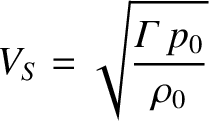
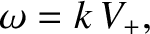
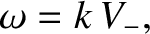
The remaining two roots of the dispersion relation (8.41) are written
and respectively. Here, Note that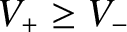 . The first root is generally termed the
fast magnetosonic wave, or fast wave, for short, whereas
the second root is usually called the slow magnetosonic
wave, or slow wave. The eigenvectors for these waves are
. The first root is generally termed the
fast magnetosonic wave, or fast wave, for short, whereas
the second root is usually called the slow magnetosonic
wave, or slow wave. The eigenvectors for these waves are
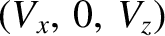 . It follows that
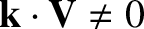 and
and
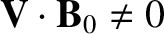 . Hence, these waves are associated with non-zero perturbations
in the plasma density and pressure, and also involve plasma motion parallel, as
well as perpendicular, to the magnetic field. The latter observation suggests
that the dispersion relations
(8.43) and (8.44) are likely to undergo significant modification in
collisionless plasmas.
. Hence, these waves are associated with non-zero perturbations
in the plasma density and pressure, and also involve plasma motion parallel, as
well as perpendicular, to the magnetic field. The latter observation suggests
that the dispersion relations
(8.43) and (8.44) are likely to undergo significant modification in
collisionless plasmas.
In order to better understand the nature of the fast and slow waves, let us
consider the cold plasma limit, which is obtained by letting the sound
speed,  , tend to zero. In this limit, the slow wave ceases to exist (in fact,
its phase-velocity tends to zero), whereas the dispersion relation for
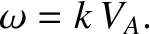
the fast wave reduces to
, tend to zero. In this limit, the slow wave ceases to exist (in fact,
its phase-velocity tends to zero), whereas the dispersion relation for
the fast wave reduces to
 |
(8.46) |
In the limit
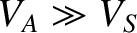 , which is appropriate to low-
 plasmas (see
Section 4.16), the dispersion relation for the slow wave reduces to
plasmas (see
Section 4.16), the dispersion relation for the slow wave reduces to
 |
(8.47) |
plasmas, the slow
wave is a sound wave modified by the presence of the magnetic field.
The distinction between the fast and slow waves can be further understood
by comparing the signs of the wave-induced fluctuations in the plasma and magnetic
pressures:  and
and
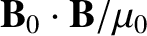 , respectively.
It follows from Equation (8.36) that
, respectively.
It follows from Equation (8.36) that
-component of Equation (8.31) yields
Combining Equations (8.35), (8.39), (8.40), (8.48), and (8.49), we obtain
 |
(8.50) |
and
have the same sign
if
 , and the opposite sign if
 . Here,
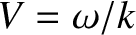 is the phase-velocity. It is
straightforward to show that
is the phase-velocity. It is
straightforward to show that
 , and
, and
 .
Thus, we conclude that the plasma pressure and
magnetic pressure fluctuations reinforce one another in the fast magnetosonic wave, whereas the
fluctuations oppose one another in the slow magnetosonic wave.
.
Thus, we conclude that the plasma pressure and
magnetic pressure fluctuations reinforce one another in the fast magnetosonic wave, whereas the
fluctuations oppose one another in the slow magnetosonic wave.
![\includegraphics[height=3in]{Chapter08/fig8_1.eps}](img2748.png) |
Figure 8.1 shows the variation of the phase velocities of the three MHD waves with direction of propagation in the
- plane for a low- plasma in which 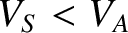 . It can be
seen that the slow wave always has a smaller phase-velocity than the
shear-Alfvén wave, which, in turn, always has a smaller phase-velocity than the fast wave.
. It can be
seen that the slow wave always has a smaller phase-velocity than the
shear-Alfvén wave, which, in turn, always has a smaller phase-velocity than the fast wave.
The existence of MHD waves was first predicted theoretically by Alfvén (Alfvén 1942). These waves were subsequently observed in the laboratory—first in magnetized conducting fluids (e.g., mercury) (Lundquist 1949), and then in magnetized plasmas (Wilcox, Boley, and DeSilva 1960).



![$\displaystyle \left[ \omega^2 - \frac{({\bf k}\cdot{\bf B}_0)^2}{\mu_0\,\rho_0}
\right] {\bf V} =$](img2719.png)

![\begin{displaymath}\left(
\begin{array}{ccc}
{ \omega^2 - k^2\,V_A^{2} -k^2\,V_S...
...}{c}V_x\\ [0.5ex]
V_y\\ [0.5ex] V_z\end{array}\right) = {\bf0}.\end{displaymath}](img2721.png)
![$\displaystyle (\omega^2 - k^2\,V_A^{2}\,\cos^2\theta)\left[
\omega^4 - \omega^2\,k^2\,(V_A^{2}+V_S^{2}) + k^4\,V_A^{2}\,V_S^{2}\,\cos^2\theta
\right] = 0.$](img2724.png)

![$\displaystyle V_\pm = \left\{\frac{1}{2}\left[V_A^{2} + V_S^{2} \pm \sqrt{
(V_A^{2} + V_S^{2})^{2} - 4\, V_A^{2}\,V_S^{2}\,\cos^2\theta}
\,\right]\right\}^{1/2}.$](img2731.png)

