Next: Wavefunction Collapse Up: Wave Mechanics Previous: Wave Dispersion
 -space, with characteristic
width
-space, with characteristic
width
 , is also localized in
  -space, with characteristic
width
-space, with characteristic
width
 . However, as time progresses,
the width of the wave packet in -space increases [see Equation (4.63)], while that of the packet in -space stays the same [because
. However, as time progresses,
the width of the wave packet in -space increases [see Equation (4.63)], while that of the packet in -space stays the same [because
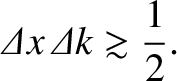
 is given by Equation (4.45) at all times]. Hence,
in general, we can say that
is given by Equation (4.45) at all times]. Hence,
in general, we can say that
 |
(4.64) |
and
 as
characterizing our uncertainty regarding the values of the particle's
position and wavenumber, respectively.
as
characterizing our uncertainty regarding the values of the particle's
position and wavenumber, respectively.
A measurement of a particle's wavenumber, , is equivalent to
a measurement of its momentum,  , because
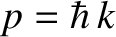 . Hence,
an uncertainty in of order
translates to
an uncertainty in of order
. Hence,
an uncertainty in of order
translates to
an uncertainty in of order
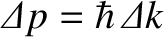 .
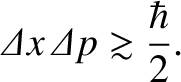
It follows, from the previous inequality, that
.
It follows, from the previous inequality, that
It is apparent, from Equation (4.63),
that a particle wave packet of initial spatial extent
 spreads out in such a manner that its spatial extent becomes
 .
It is readily demonstrated that this spreading of the wave packet is a consequence of the
uncertainty principle. Indeed, because the initial uncertainty in the particle's
position is
, it follows that the uncertainty in its
momentum is of order
.
It is readily demonstrated that this spreading of the wave packet is a consequence of the
uncertainty principle. Indeed, because the initial uncertainty in the particle's
position is
, it follows that the uncertainty in its
momentum is of order
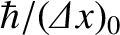 . This translates to an uncertainty
in velocity of
. This translates to an uncertainty
in velocity of
![${\mit\Delta}v = \hbar/[m\,({\mit\Delta}x)_0]$](img3011.png) . Thus,
if we imagine that part of the wave packet propagates at
. Thus,
if we imagine that part of the wave packet propagates at
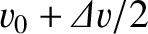 , and another part at
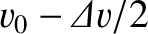 , where
  is
the mean propagation velocity, then it follows that the wave packet will
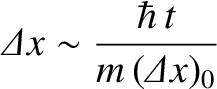
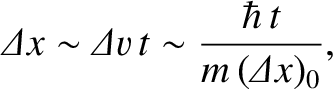
spread out as time progresses. Indeed, at large , we expect the
width of the wave packet to be
is
the mean propagation velocity, then it follows that the wave packet will
spread out as time progresses. Indeed, at large , we expect the
width of the wave packet to be
 |
(4.67) |