


Next: Spherical Harmonics
Up: Orbital Angular Momentum
Previous: Eigenvalues of
Eigenvalues of 
Consider the angular wavefunction
 . We know that
 |
(576) |
since
 is a positive-definite real quantity.
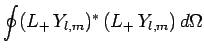
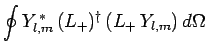
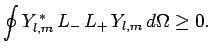
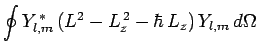
Hence, making use of Eqs. (194) and (539), we find that
is a positive-definite real quantity.
Hence, making use of Eqs. (194) and (539), we find that
It follows from Eqs. (541), and (556)-(558) that
We, thus, obtain the constraint
 |
(579) |
Likewise, the inequality
 |
(580) |
leads to a second constraint:
 |
(581) |
Without loss of generality, we can assume that  . This
is reasonable, from a physical standpoint, since
. This
is reasonable, from a physical standpoint, since
 is supposed to represent the magnitude squared of something, and
should, therefore, only take non-negative values. If
is supposed to represent the magnitude squared of something, and
should, therefore, only take non-negative values. If  is non-negative
then the constraints (579) and (581) are equivalent
to the following constraint:
is non-negative
then the constraints (579) and (581) are equivalent
to the following constraint:
 |
(582) |
We, thus, conclude that the quantum number  can only take a restricted range of integer values.
Well, if can only take a restricted range of integer values then there
must exist a lowest possible value it can take. Let us call this special value  ,
and let
,
and let  be the corresponding eigenstate. Suppose
we act on this eigenstate with the lowering operator
be the corresponding eigenstate. Suppose
we act on this eigenstate with the lowering operator  . According
to Eq. (560), this will have the effect of converting the
eigenstate into that of a state with a lower value of . However,
no such state exists. A non-existent state is represented in quantum
mechanics by the null wavefunction,
. According
to Eq. (560), this will have the effect of converting the
eigenstate into that of a state with a lower value of . However,
no such state exists. A non-existent state is represented in quantum
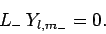
mechanics by the null wavefunction,  . Thus, we must have
 |
(583) |
Now, from Eq. (540),
 |
(584) |
Hence,
 |
(585) |
or
 |
(586) |
where use has been made of (556), (557), and (583).
It follows that
 |
(587) |
Assuming that is negative, the solution to the above equation
is
 |
(588) |
We can similarly show that the largest possible value of is
 |
(589) |
The above two results imply that is an integer, since
and  are both constrained to be integers.
We can now formulate the rules which determine the allowed values
of the quantum numbers and . The quantum number
takes the non-negative integer values
 . Once
is given, the quantum number can take any integer value in the
range
. Once
is given, the quantum number can take any integer value in the
range
 |
(590) |
Thus, if  then can only take the value
  , if
, if  then
can take the values
then
can take the values  , if
, if  then can take
the values
then can take
the values 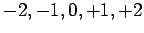 , and so on.
Next: Spherical Harmonics
Up: Orbital Angular Momentum
Previous: Eigenvalues of
Richard Fitzpatrick
2010-07-20

![$\displaystyle \oint Y_{l,m}^{ \ast} \hbar^2\left[l (l+1) -m (m+1)\right]Y_{l,m} d\Omega$](img1411.png)
![$\displaystyle \hbar^2 \left[l (l+1) -m (m+1)\right] \oint Y_{l,m}^{ \ast} Y_{l,m} d\Omega$](img1412.png)
![$\displaystyle \hbar^2 \left[l (l+1) -m (m+1)\right]\geq 0.$](img1413.png)