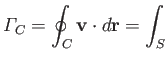
situated entirely within a moving fluid. The
vector line integral (see Section A.14)
situated entirely within a moving fluid. The
vector line integral (see Section A.14)
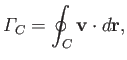 |
(4.76) |
 is an element of
, and the integral is taken around the whole curve, is termed the circulation of the flow around the curve.
The sense of circulation (i.e., either clockwise or counter-clockwise) is arbitrary.
is an element of
, and the integral is taken around the whole curve, is termed the circulation of the flow around the curve.
The sense of circulation (i.e., either clockwise or counter-clockwise) is arbitrary.
Let  be a surface having the closed curve
for a boundary, and let
be a surface having the closed curve
for a boundary, and let  be an element of this surface (see Section A.7) with that direction of the normal which is related to the chosen sense of circulation around
by the right-hand
circulation rule. (See Section A.8.) According to the curl theorem (see Section A.22),
be an element of this surface (see Section A.7) with that direction of the normal which is related to the chosen sense of circulation around
by the right-hand
circulation rule. (See Section A.8.) According to the curl theorem (see Section A.22),
is equal to the net sum of the intensities of the
vortex filaments passing through the loop and piercing the surface
(with a filament making a
positive, or negative, contribution to the sum depending on whether it pierces the surface
in the direction determined by the chosen sense of circulation around
and the right-hand circulation rule, or in the opposite direction).
One important proviso to Equation (4.77) is that the surface
must lie entirely within the fluid.