


Next: Two-State System
Up: Time-Dependent Perturbation Theory
Previous: Introduction
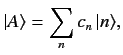
Suppose that at  the state of the system is represented by
 |
(741) |
where the  are complex numbers. Thus, the initial state is some
linear superposition of the unperturbed
energy eigenstates. In the absence of the
time-dependent perturbation, the time evolution of the system is
given by
are complex numbers. Thus, the initial state is some
linear superposition of the unperturbed
energy eigenstates. In the absence of the
time-dependent perturbation, the time evolution of the system is
given by
![$\displaystyle \vert A, t_0, t\rangle = \sum_n c_n \exp[-{\rm i}\,E_n \,(t-t_0)/\hbar]\,\vert n\rangle.$](img1780.png) |
(742) |
Now, the probability of finding the system in state  at time
 is
is
![$\displaystyle P_n(t) = \vert c_n \exp[-{\rm i}\,E_n (t-t_0)/\hbar]\vert^{\,2} = \vert c_n\vert^{\,2} = P_n(t_0).$](img1781.png) |
(743) |
Clearly, with  , the probability of finding the system in
state
at time
is exactly the same as the probability
of finding the system in this state at the initial time
, the probability of finding the system in
state
at time
is exactly the same as the probability
of finding the system in this state at the initial time  . However,
with
. However,
with  , we expect
  to vary with time. Thus, we can
write
to vary with time. Thus, we can
write
![$\displaystyle \vert A, t_0, t\rangle = \sum_n c_n(t) \exp[-{\rm i}\,E_n\,(t-t_0)/\hbar]\,\vert n\rangle,$](img1785.png) |
(744) |
where
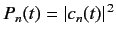 . Here, we have carefully separated the fast
phase oscillation of the eigenkets, which depends on the unperturbed
Hamiltonian, from the slow variation of the amplitudes
. Here, we have carefully separated the fast
phase oscillation of the eigenkets, which depends on the unperturbed
Hamiltonian, from the slow variation of the amplitudes  , which
depends entirely on the perturbation (i.e.,
is constant if
).
Note that the eigenkets
, appearing in Equation (744), are time-independent
(they are actually the eigenkets of
, which
depends entirely on the perturbation (i.e.,
is constant if
).
Note that the eigenkets
, appearing in Equation (744), are time-independent
(they are actually the eigenkets of  evaluated at the time
).
evaluated at the time
).
Schrödinger's time evolution equation yields
 |
(745) |
It follows from Equation (744) that
![$\displaystyle (H_0+H_1)\, \vert A,t_0,t\rangle = \sum_m c_m(t) \exp[-{\rm i}\,E_m\, (t-t_0)/\hbar]\, (E_m + H_1)\,\vert m\rangle.$](img1789.png) |
(746) |
We also have
![$\displaystyle {\rm i}\,\hbar\, \frac{\partial}{\partial t}\,\vert A,t_0,t\rangl...
...{dt}+ c_m(t)\, E_m\right) \exp[-{\rm i}\,E_m \,(t-t_0)/\hbar]\, \vert m\rangle,$](img1790.png) |
(747) |
where use has been made of the time-independence of the kets
 . According to Equation (745), we can equate the right-hand sides
of the previous two equations to obtain
. According to Equation (745), we can equate the right-hand sides
of the previous two equations to obtain
![$\displaystyle \sum_m {\rm i}\,\hbar\, \frac{d c_m}{dt}\exp[-{\rm i}\,E_m \,(t-t...
...gle = \sum_m c_m(t) \exp[-{\rm i}\,E_m \,(t-t_0)/\hbar]\, H_1\, \vert m\rangle.$](img1792.png) |
(748) |
Left-multiplication by
 yields
![$\displaystyle {\rm i}\,\hbar\, \frac{d c_n}{dt} = \sum_m H_{nm}(t)\, \exp[\,{\rm i}\,\omega_{nm}\, (t-t_0)]\, c_m(t),$](img1794.png) |
(749) |
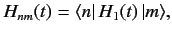
where
 |
(750) |
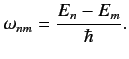
and
 |
(751) |
Here, we have made use of the standard orthonormality result,
 . Suppose that there are
  linearly independent eigenkets
of the unperturbed Hamiltonian. According to Equation (749), the
time variation of the coefficients
, which specify the
probability of finding the system in state
at time
,
is determined by
coupled first-order differential equations. Note
that Equation (749) is exact--we have made no approximations at this stage.
Unfortunately, we cannot generally find exact solutions to this equation,
so we have to obtain approximate solutions via suitable expansions in small
quantities. However, for the particularly simple case of a two-state system
(i.e.,
linearly independent eigenkets
of the unperturbed Hamiltonian. According to Equation (749), the
time variation of the coefficients
, which specify the
probability of finding the system in state
at time
,
is determined by
coupled first-order differential equations. Note
that Equation (749) is exact--we have made no approximations at this stage.
Unfortunately, we cannot generally find exact solutions to this equation,
so we have to obtain approximate solutions via suitable expansions in small
quantities. However, for the particularly simple case of a two-state system
(i.e.,  ), it is actually possible to solve Equation (749) without
approximation. This
solution is of great practical importance.
), it is actually possible to solve Equation (749) without
approximation. This
solution is of great practical importance.
Next: Two-State System
Up: Time-Dependent Perturbation Theory
Previous: Introduction
Richard Fitzpatrick
2013-04-08