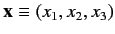
 be a set of Cartesian position operators, and let
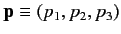 be
the corresponding momentum operators. Demonstrate that
be
the corresponding momentum operators. Demonstrate that
![$\displaystyle [x_i, F({\bf x},{\bf p})]$](img591.png) |
 |
|
![$\displaystyle [p_i, G({\bf x},{\bf p})]$](img593.png) |
 |
 , and
, and
 ,
,
 are functions that can be expanded as power series.
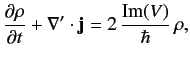
 is complex, demonstrate that the Schrödinger time-dependent wave equation, (274), can be transformed to give
where
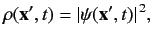
and
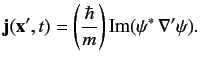
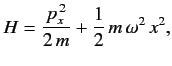
where
 and
and  are conjugate position and momentum operators, respectively, and
  ,
,  are
positive constants.
are
positive constants.
 , for a general state, is
positive definite.
, for a general state, is
positive definite.
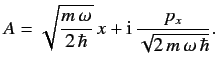
Deduce that
![$\displaystyle [A,A^\dag ]$](img666.png) |
 |
|
 |
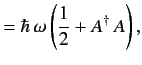 |
|
![$\displaystyle [H,A]$](img670.png) |
 |
|
![$\displaystyle [H,A^\dag ]$](img672.png) |
 |
 is an eigenket of the Hamiltonian whose corresponding energy is
  : i.e.,
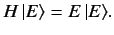
Demonstrate that
 |
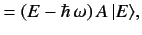 |
|
 |
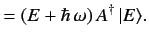 |
are
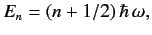
where
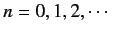 .
.
 be a properly normalized (i.e.,
 ) energy eigenket corresponding to the
eigenvalue
) energy eigenket corresponding to the
eigenvalue  . Show that the kets can be defined such that
 |
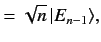 |
|
 |
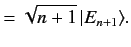 |
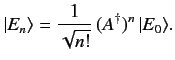
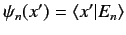 be the wavefunctions of the properly normalized energy eigenkets.
Given that
be the wavefunctions of the properly normalized energy eigenkets.
Given that

deduce that
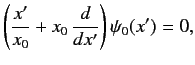
where
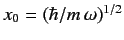 . Hence, show that
![$\displaystyle \psi_n(x') = \frac{1}{\pi^{1/4}\,(2^n\,n!)^{1/2}\,x_0^{\,n+1/2}}\...
...c{d}{dx'}\right)^n\exp\left[-\frac{1}{2}\left(
\frac{x'}{x_0}\right)^2\right].
$](img695.png)
 be
a properly normalized energy eigenket belonging to the eigenvalue
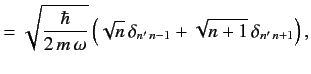
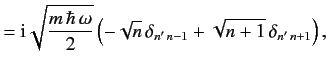
. Show that
be
a properly normalized energy eigenket belonging to the eigenvalue
. Show that
 |
 |
|
 |
 |
|
 |
 |
|
 |
 |

for the
 th eigenstate.
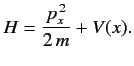
By calculating
![$ [[H,x], x]$](img707.png) , demonstrate that
, demonstrate that
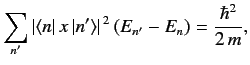
where
is a properly normalized energy eigenket corresponding to the eigenvalue
, and the
sum is over all eigenkets.
Suppose that the potential is periodic, such that
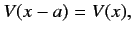
for all
. Deduce that
![$\displaystyle [D(a),H] = 0,
$](img710.png)
where
 is the displacement operator defined in Exercise 4. Hence, show that the wavefunction of
an energy eigenstate has the general form
is the displacement operator defined in Exercise 4. Hence, show that the wavefunction of
an energy eigenstate has the general form
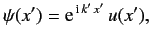
where
 is a real parameter, and
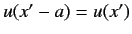 for all
  . This result is known as the Bloch theorem.
 and
and  are
are
 |
 |
|
 |
 |
 |
 |
|
 |
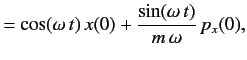 |
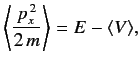
and
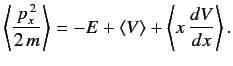
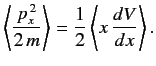
[Hint: You can assume, without loss of generality, that the stationary wavefunction is real.] Hence, prove the Virial theorem,