


Next: Schrödinger Representation
Up: Position and Momentum
Previous: Poisson Brackets
Consider a simple system with one classical degree of freedom, which corresponds to
the Cartesian coordinate  . Suppose that
is free to take any value (e.g.,
could be the position of a free particle). The classical dynamical variable
is represented in quantum
mechanics as a linear Hermitian operator which is also called
.
Moreover, the operator
possesses eigenvalues
. Suppose that
is free to take any value (e.g.,
could be the position of a free particle). The classical dynamical variable
is represented in quantum
mechanics as a linear Hermitian operator which is also called
.
Moreover, the operator
possesses eigenvalues  lying in the continuous
range
lying in the continuous
range
 (since the eigenvalues
correspond to all the possible results of a measurement of
). We can
span ket space using the suitably normalized eigenkets of
.
An eigenket corresponding to the eigenvalue
is denoted
(since the eigenvalues
correspond to all the possible results of a measurement of
). We can
span ket space using the suitably normalized eigenkets of
.
An eigenket corresponding to the eigenvalue
is denoted
 .
Moreover,
[see Equation (85)]
.
Moreover,
[see Equation (85)]
 |
(117) |
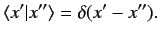
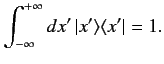
The eigenkets satisfy the extremely useful relation [see Equation (87)]
 |
(118) |
This formula expresses the fact that the eigenkets are complete, mutually
orthogonal, and suitably normalized.
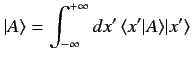
A state ket  (which represents a general state
  of the system)
can be expressed as a linear superposition of the eigenkets of the position
operator using Equation (118). Thus,
of the system)
can be expressed as a linear superposition of the eigenkets of the position
operator using Equation (118). Thus,
 |
(119) |
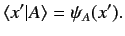
The quantity
 is a complex function of the position eigenvalue
. We can write
is a complex function of the position eigenvalue
. We can write
 |
(120) |
Here,
 is the famous wavefunction of quantum mechanics.
Note that state
is completely specified by its wavefunction
[because the wavefunction can be used to reconstruct the state ket
using Equation (119)].
It is clear that the wavefunction of state
is simply the collection
of the weights of the corresponding state ket
,
when it is expanded in terms of the eigenkets of the
position operator. Recall, from Section 1.10, that the probability of
a measurement of a dynamical variable
is the famous wavefunction of quantum mechanics.
Note that state
is completely specified by its wavefunction
[because the wavefunction can be used to reconstruct the state ket
using Equation (119)].
It is clear that the wavefunction of state
is simply the collection
of the weights of the corresponding state ket
,
when it is expanded in terms of the eigenkets of the
position operator. Recall, from Section 1.10, that the probability of
a measurement of a dynamical variable  yielding the result
  when the system is in state
is given by
when the system is in state
is given by
 , assuming that
the
eigenvalues of
are discrete. This result is easily generalized to dynamical
variables possessing continuous eigenvalues. In fact, the probability of
a measurement of
yielding a result lying in the range
to
, assuming that
the
eigenvalues of
are discrete. This result is easily generalized to dynamical
variables possessing continuous eigenvalues. In fact, the probability of
a measurement of
yielding a result lying in the range
to  when the system is in a state
is
when the system is in a state
is
 .
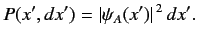
In other words, the probability of a measurement of position yielding a
result in the range
to
when the wavefunction of the system is
is
.
In other words, the probability of a measurement of position yielding a
result in the range
to
when the wavefunction of the system is
is
 |
(121) |
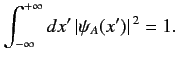
This formula is only valid if the state ket
is properly normalized:
i.e., if
 . The corresponding normalization for
the wavefunction is
. The corresponding normalization for
the wavefunction is
 |
(122) |
Consider a second state  represented by a state ket
  and
a wavefunction
and
a wavefunction
 . The inner product
 can be written
 |
(123) |
where use has been made of Equations (118) and (120). Thus, the inner product of two states is
related to the overlap integral of their wavefunctions.
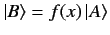
Consider a general function  of the observable
[e.g.,
of the observable
[e.g.,  ].
If
].
If
 then it follows that
 |
(124) |
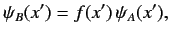
giving
 |
(125) |
where use has been made of Equation (117). Here,  is the same function
of the position eigenvalue
that
is of the position operator
:
i.e., if
then
is the same function
of the position eigenvalue
that
is of the position operator
:
i.e., if
then
 . It follows, from the above result,
that a general state ket
can be written
. It follows, from the above result,
that a general state ket
can be written
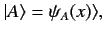 |
(126) |
where  is the same function of the operator
that the wavefunction
is of the position eigenvalue
, and the ket
is the same function of the operator
that the wavefunction
is of the position eigenvalue
, and the ket  has the
wavefunction
has the
wavefunction
 . The ket
is termed the standard ket.
The dual of the standard ket is termed the standard bra, and is
denoted
. The ket
is termed the standard ket.
The dual of the standard ket is termed the standard bra, and is
denoted  . It is
easily seen that
. It is
easily seen that
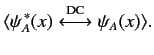 |
(127) |
Note, finally, that
 is often shortened to
 , leaving
the dependence on the position operator
tacitly understood.
, leaving
the dependence on the position operator
tacitly understood.
Next: Schrödinger Representation
Up: Position and Momentum
Previous: Poisson Brackets
Richard Fitzpatrick
2013-04-08