Next: Extension to Oblique Incidence
Up: Wave Propagation in Inhomogeneous
Previous: WKB Approximation
Consider an ionosphere in which the refractive index is a slowly varying
function of height  above the surface of
the Earth. Let
above the surface of
the Earth. Let  be positive for
  , and negative for
 . Suppose that an upgoing radio wave of amplitude
  is
generated at ground level (
is
generated at ground level ( ). The complex amplitude of the wave in the region
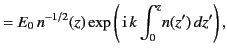
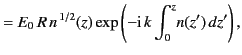
 is given by the upgoing WKB solution
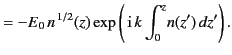
The upgoing energy flux is given by
 .
In the region
, the WKB solution takes the form
.
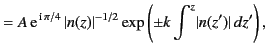
In the region
, the WKB solution takes the form
where  is a constant.
These solutions correspond to exponentially growing or decaying waves. Note that
the magnetic components of the waves are in phase quadrature with the
electric components. This implies that the Poynting fluxes of the waves are
zero: in other words„ the waves do not transmit energy. Thus, there is a
non-zero incident energy flux in the region
, and zero energy flux in the
region
. Clearly, the incident wave is either absorbed or reflected
in the vicinity of the plane
is a constant.
These solutions correspond to exponentially growing or decaying waves. Note that
the magnetic components of the waves are in phase quadrature with the
electric components. This implies that the Poynting fluxes of the waves are
zero: in other words„ the waves do not transmit energy. Thus, there is a
non-zero incident energy flux in the region
, and zero energy flux in the
region
. Clearly, the incident wave is either absorbed or reflected
in the vicinity of the plane  (where
  ). In fact, as we shall prove later, the
wave is reflected. The complex amplitude of the reflected wave
in the region
is
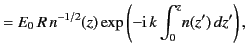
given by the downgoing WKB solution
). In fact, as we shall prove later, the
wave is reflected. The complex amplitude of the reflected wave
in the region
is
given by the downgoing WKB solution
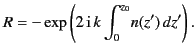
where  is the coefficient of reflection. Suppose, for the
sake of argument, that the plane
acts like a perfect conductor, so that
is the coefficient of reflection. Suppose, for the
sake of argument, that the plane
acts like a perfect conductor, so that
 . It follows that
 |
(1086) |
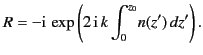
In fact, as we shall prove later, the correct answer is
 |
(1087) |
Thus, there is only a  phase shift at the reflection point, instead of the
 phase shift that would be obtained if the plane
acted like a perfect conductor.
phase shift that would be obtained if the plane
acted like a perfect conductor.
Next: Extension to Oblique Incidence
Up: Wave Propagation in Inhomogeneous
Previous: WKB Approximation
Richard Fitzpatrick
2014-06-27