).
Unfortunately, ferromagnetic materials do not exhibit a linear
dependence between
).
Unfortunately, ferromagnetic materials do not exhibit a linear
dependence between  and
and  , or between
  and
,
so that we cannot employ Equations (691) and (692) with constant values
of
and
,
so that we cannot employ Equations (691) and (692) with constant values
of  and
and  . It is still expedient to use Equation (692) as the
definition of
, with
. It is still expedient to use Equation (692) as the
definition of
, with
 . However,
this practice leads to complications under certain circumstances.
In fact, the permeability of a ferromagnetic material, as defined by
Equation (692), can vary through the entire range of possible values
from zero to infinity, and may be either positive or negative. The most
sensible
approach is to consider each problem involving ferromagnetic materials
separately, try to determine which region of the
-
diagram
is important for the particular case in hand, and then
make approximations appropriate
to this region.
. However,
this practice leads to complications under certain circumstances.
In fact, the permeability of a ferromagnetic material, as defined by
Equation (692), can vary through the entire range of possible values
from zero to infinity, and may be either positive or negative. The most
sensible
approach is to consider each problem involving ferromagnetic materials
separately, try to determine which region of the
-
diagram
is important for the particular case in hand, and then
make approximations appropriate
to this region.
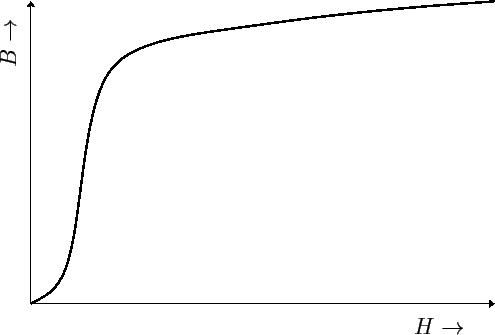
Let us, first, consider an unmagnetized sample of ferromagnetic material.
If the magnetic intensity, which is initially zero, is increased
monotonically, then the
-
relationship
traces out a curve such as that shown in Figure 2. This is called a
magnetization curve. It is evident that the permeabilities
derived from the curve (according to the rule  ) are
always positive, and show a wide range of values. The maximum permeability
occurs at the ``knee'' of the curve. In some materials this
maximum permeability is as large as
) are
always positive, and show a wide range of values. The maximum permeability
occurs at the ``knee'' of the curve. In some materials this
maximum permeability is as large as
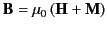
 . The reason for
the knee in the curve is that the magnetization
reaches
a maximum value in the material, so that
. The reason for
the knee in the curve is that the magnetization
reaches
a maximum value in the material, so that
 |
(693) |
only because of the
 term. The maximum value of
is
called the saturation magnetization of the material.
term. The maximum value of
is
called the saturation magnetization of the material.
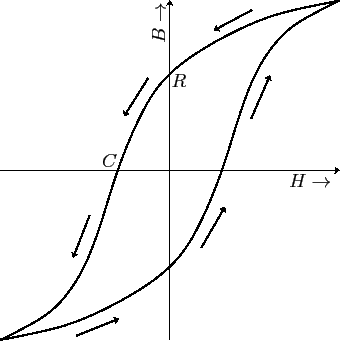
Next, consider a ferromagnetic sample magnetized by the previously described procedure.
If the magnetic intensity
is decreased then the
-
relation does not follow back down the curve of Figure 2, but instead
moves along a new curve, shown in Figure 3, to the point  .
The magnetization, once established, does not disappear with the removal
of
. In fact, it takes a reversed magnetic intensity to
reduce the magnetization to zero. If
continues to
build up in the reversed direction then
(and,
hence,
) becomes increasingly negative. Finally,
if
increases again then the operating point follows the lower
curve of Figure 3. Thus, the
-
curve for
increasing
is quite different to that for decreasing
. This phenomenon is known as hysteresis.
.
The magnetization, once established, does not disappear with the removal
of
. In fact, it takes a reversed magnetic intensity to
reduce the magnetization to zero. If
continues to
build up in the reversed direction then
(and,
hence,
) becomes increasingly negative. Finally,
if
increases again then the operating point follows the lower
curve of Figure 3. Thus, the
-
curve for
increasing
is quite different to that for decreasing
. This phenomenon is known as hysteresis.
The loop shown in Figure 3 is called the hysteresis loop of the material
in question. The value of
at the point
is called the
retentivity or remanence. The magnitude of
at
the point  is called the coercivity. It is
evident that
is negative in the second and fourth quadrants
of the loop, and positive in the first and third quadrants. The shape
of the hysteresis loop depends not only on the nature of
the ferromagnetic material, but also on the maximum value of
to which the material has been subjected. However, once this maximum
value,
is called the coercivity. It is
evident that
is negative in the second and fourth quadrants
of the loop, and positive in the first and third quadrants. The shape
of the hysteresis loop depends not only on the nature of
the ferromagnetic material, but also on the maximum value of
to which the material has been subjected. However, once this maximum
value,
 , becomes sufficient to produce saturation in the material, the hysteresis loop does not change shape with any further
increase in
.
, becomes sufficient to produce saturation in the material, the hysteresis loop does not change shape with any further
increase in
.
Ferromagnetic materials are used either to channel magnetic flux
(e.g., around transformer circuits), or as sources of magnetic
field (e.g., permanent magnets). For use as a permanent magnet, the
material is first magnetized by placing it in a strong magnetic
field. However, once the magnet is removed from the external field,
it is subject to a demagnetizing
. Thus, it is vitally important
that a permanent magnet should possess both a large remanence and a large
coercivity. As will become
clear, later on, it is generally a good idea for the ferromagnetic materials
used to channel magnetic flux around transformer circuits to
possess small remanences and small coercivities.