


 is the potential due to a volume
charge density
is the potential due to a volume
charge density  within a volume
  and a surface charge density
  on the conducting surface
  bounding the
volume
, while
bounding the
volume
, while  is the potential due to another charge distribution
  and
and  (non-simultaneously occupying the same volume and the same
surface, respectively), then
(non-simultaneously occupying the same volume and the same
surface, respectively), then

 . A point charge
  is
placed between the planes. Use Green's reciprocation theorem to prove that the total charge induced on
one of the planes is equal to
is
placed between the planes. Use Green's reciprocation theorem to prove that the total charge induced on
one of the planes is equal to  times the fractional perpendicular distance of the point charge from the
other plane. [Hint: Choose as your comparison electrostatic problem with the same surfaces one whose charge
densities and potential are known and simple.]
times the fractional perpendicular distance of the point charge from the
other plane. [Hint: Choose as your comparison electrostatic problem with the same surfaces one whose charge
densities and potential are known and simple.]
 be the
potential of the first conductor when it is uncharged and the second conductor holds a
charge
be the
potential of the first conductor when it is uncharged and the second conductor holds a
charge  . Likewise, let
  be the potential of the second conductor
when it is uncharged and the first conductor holds a charge
. Use Green's
reciprocation theorem to demonstrate that
be the potential of the second conductor
when it is uncharged and the first conductor holds a charge
. Use Green's
reciprocation theorem to demonstrate that

 . Let the second be sufficiently small that it
can effectively be treated as a point charge, and let it also be located a distance
. Let the second be sufficiently small that it
can effectively be treated as a point charge, and let it also be located a distance  from
the center of the first. Suppose that the first conductor is uncharged, and that the second carries a charge
. What is the potential of the first conductor?
[Hint: Consider the result proved in Exercise 1.]
from
the center of the first. Suppose that the first conductor is uncharged, and that the second carries a charge
. What is the potential of the first conductor?
[Hint: Consider the result proved in Exercise 1.]
 conductors distributed in a vacuum. Suppose that
the
conductors distributed in a vacuum. Suppose that
the  th conductor carries the charge
  and is at the scalar potential
 . It follows from the linearity of Maxwell's equations and Ohm's law
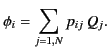
that a linear relationship exists between the potentials and the charges:
that is,
. It follows from the linearity of Maxwell's equations and Ohm's law
that a linear relationship exists between the potentials and the charges:
that is,
Here, the
 are termed the coefficients of potential. Demonstrate that
 for all
  . [Hint: Consider the result
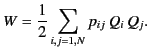
proved in Exercise 1.] Show that the total electrostatic potential energy of
the charged conductors is
. [Hint: Consider the result
proved in Exercise 1.] Show that the total electrostatic potential energy of
the charged conductors is
 ) is
) is
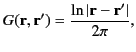
where
 , et cetera.
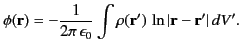
Hence, deduce that the scalar potential field generated by the two-dimensional
charge distribution
, et cetera.
Hence, deduce that the scalar potential field generated by the two-dimensional
charge distribution
 is
is
 is situated at position
 in a non-uniform external electric field
 . Demonstrate
that the net force on the dipole can be written
. Demonstrate
that the net force on the dipole can be written
 , where

is
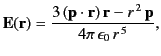
where
represents vector displacement relative to the dipole.
Show that the potential energy of an electric dipole of moment  in the electric field generated by a second dipole of moment
  is
is
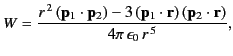
where
is the displacement of one dipole from another.
in a uniform
external electric field  is
is


Hence, deduce that the potential energy of the dipole is
 and
and  , respectively, and
is held fixed, then
, respectively, and
is held fixed, then
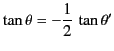
in equilibrium.