, where
  are each equal to the mass of the
first particle,
are each equal to the mass of the
first particle,  are each equal to the mass of the
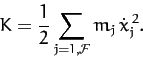
second particle, etc. Furthermore, the kinetic energy of the
system can be written
are each equal to the mass of the
second particle, etc. Furthermore, the kinetic energy of the
system can be written
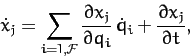
Now, since
 , we can write
 |
(602) |
.
Hence, it follows that
 . According to the
above equation,
. According to the
above equation,
 and the
  as independent
variables.
as independent
variables.
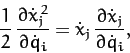
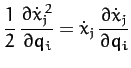
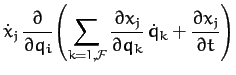
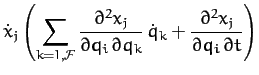
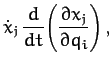
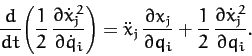
Multiplying Equation (603) by  , and then differentiating
with respect to time, we obtain
, and then differentiating
with respect to time, we obtain
 |
(608) |
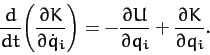
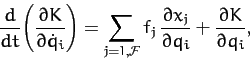
Let us take the above equation, multiply by  , and then sum over all
  .
We obtain
.
We obtain
 |
(609) |
 |
(610) |
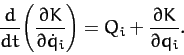
It is helpful to introduce a function  , called the Lagrangian, which
is defined as the difference between the kinetic and potential energies of the dynamical system under investigation:
, called the Lagrangian, which
is defined as the difference between the kinetic and potential energies of the dynamical system under investigation:
 is clearly independent of the
, it follows from Equation (611) that
is clearly independent of the
, it follows from Equation (611) that
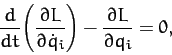
 . This equation is known as Lagrange's equation.
According to the above analysis, if we can express the kinetic and potential energies of our dynamical system solely in terms of our generalized coordinates and their time derivatives then we can immediately write down the equations of motion of the system, expressed in terms of the generalized coordinates, using Lagrange's equation, (613). Unfortunately, this scheme only works for conservative systems. Let us now consider some examples.