


 into the valley below, the
speed at the crest being
into the valley below, the
speed at the crest being  . Show that, by properly adjusting the ratio of the cross-sectional areas of the pipe
at the crest and in the valley, the pressure may be equalized at these two places. (Milne-Thomson 1958.)
. Show that, by properly adjusting the ratio of the cross-sectional areas of the pipe
at the crest and in the valley, the pressure may be equalized at these two places. (Milne-Thomson 1958.)
 and pressure
  flows through a curved pipe of
uniform cross-sectional area
flows through a curved pipe of
uniform cross-sectional area  , whose radius of curvature is
  , at the
uniform speed
. Demonstrate that there is a net force per unit length
, at the
uniform speed
. Demonstrate that there is a net force per unit length
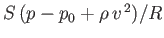 acting on the
pipe, and that this force is everywhere directed away from the pipe's local center of curvature. Here,
acting on the
pipe, and that this force is everywhere directed away from the pipe's local center of curvature. Here,  is atmospheric pressure.
above the vertex. Let  be the initial
radius of the surface of the water inside the tank. A small hole of area
(that is much less than
be the initial
radius of the surface of the water inside the tank. A small hole of area
(that is much less than
 )
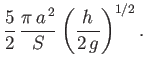
is made at the bottom of the tank. Demonstrate that the time required to empty the tank is at least
)
is made at the bottom of the tank. Demonstrate that the time required to empty the tank is at least
, and initially fills the tank to a height  above
its lowest point. A small hole of area
(that is much less than
) is made
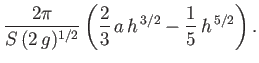
at the bottom of the tank. Demonstrate that the time required to empty the tank is at least
above
its lowest point. A small hole of area
(that is much less than
) is made
at the bottom of the tank. Demonstrate that the time required to empty the tank is at least
 and
and  , are independent of height. A
small hole of area
(where
, are independent of height. A
small hole of area
(where  ,
) is made in the wall connecting the tanks. Assuming that the initial
difference in water level between the two tanks is
, show that the time
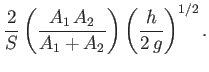
required for the water levels to equilibrate is at least
,
) is made in the wall connecting the tanks. Assuming that the initial
difference in water level between the two tanks is
, show that the time
required for the water levels to equilibrate is at least
 , having a discharge rate
  , show that there is
a critical depth
, show that there is
a critical depth  , where
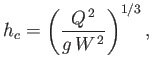
which must be exceeded before a hydraulic jump is possible.
 , and the downstream Froude number
 ,
are related by
,
are related by
![$\displaystyle {\rm Fr}_2^{\,2} =\frac{8\,{\rm Fr}_1^{\,2}}{[(1+8\,{\rm Fr}_1^{\,2})^{1/2}-1]^{\,3}}.
$](img1608.png)
 whose boundary is the surface
. Suppose that
contains an
incompressible fluid whose motion is irrotational. Let the velocity potential
whose boundary is the surface
. Suppose that
contains an
incompressible fluid whose motion is irrotational. Let the velocity potential  be constant over
. Prove that
has the same constant value throughout
. [Hint: Consider the identity
be constant over
. Prove that
has the same constant value throughout
. [Hint: Consider the identity
 .]
.]
taking a constant value on the boundary, the
normal velocity is everywhere zero on the boundary. Show that
is constant throughout
.
bounded by a surface
.
The normal flow at the boundary is prescribed. Show that the flow pattern with the lowest kinetic
energy is irrotational. This result is known as the Kelvin minimum energy theorem. [Hint: Try writing
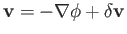 , where
is the
velocity potential of the irrotational flow pattern. Let
, where
is the
velocity potential of the irrotational flow pattern. Let
 throughout
, and
throughout
, and
 on
. Show that the kinetic energy is lowest when
on
. Show that the kinetic energy is lowest when
 throughout
.]
throughout
.]