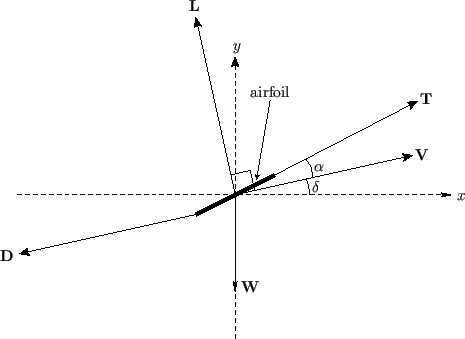
is a horizontal coordinate,
and
is a horizontal coordinate,
and  a vertical coordinate. The center of mass of the
aircraft is assumed to be moving with some fixed velocity
a vertical coordinate. The center of mass of the
aircraft is assumed to be moving with some fixed velocity  that subtends an angle
  with the horizontal. Thus,
the wind velocity in the aircraft's rest frame is
with the horizontal. Thus,
the wind velocity in the aircraft's rest frame is  . Let the aircraft's wings, which are assumed to be parallel to
its fuselage, be inclined at an angle
. Let the aircraft's wings, which are assumed to be parallel to
its fuselage, be inclined at an angle
 to the horizontal. It follows that
  is the angle of attack. The
aircraft is subject to four forces: the thrust,
is the angle of attack. The
aircraft is subject to four forces: the thrust,  , developed by its engine, which is assumed to act parallel to its fuselage; the
lift
, developed by its engine, which is assumed to act parallel to its fuselage; the
lift  , which acts at right-angles to
; the induced drag,
, which acts at right-angles to
; the induced drag,  , which acts in the opposite
direction to
; and the weight,
, which acts in the opposite
direction to
; and the weight,  , which acts vertically downward.
Vertical force balance yields
and
are both small.
According to Equations (9.108) and (9.109),
 and
and
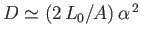 . Thus,
 and
and
 .
Moreover, it is clear from Equations (9.111) and (9.112) that
.
Moreover, it is clear from Equations (9.111) and (9.112) that
 and
and
 . Thus,
to lowest order in
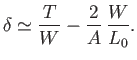
, Equation (9.111) yields
. Thus,
to lowest order in
, Equation (9.111) yields
 |
(9.115) |
 , and wing surface area,
  , (which implies that
  is fixed) this angle can be minimized by making the wing aspect-ratio,
  , as large as possible.
This result explains accounts for the fact that gliders (and albatrosses) have long thin wings, rather than short stubby ones. For a powered aircraft, the critical
thrust to weight ratio required to maintain level flight (i.e.,
, as large as possible.
This result explains accounts for the fact that gliders (and albatrosses) have long thin wings, rather than short stubby ones. For a powered aircraft, the critical
thrust to weight ratio required to maintain level flight (i.e.,  ) is
) is
 |
(9.116) |
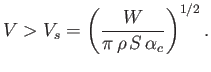
 then boundary layer separation occurs on the back sides of the wings, giving rise to a greatly increased level of drag acting on the aircraft. In aerodynamics, this phenomenon
is called a stall. As is clear from Equations (9.110) and (9.113), the requirement
then boundary layer separation occurs on the back sides of the wings, giving rise to a greatly increased level of drag acting on the aircraft. In aerodynamics, this phenomenon
is called a stall. As is clear from Equations (9.110) and (9.113), the requirement
 is equivalent to
 |
(9.117) |
 , which is known as the stall speed. Note
that the stall speed decreases with decreasing altitude, as the air becomes denser.
, which is known as the stall speed. Note
that the stall speed decreases with decreasing altitude, as the air becomes denser.