


Next: Laplacian Operator Up: Vector Algebra and Vector Previous: Grad Operator
 . Consider
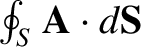 over some closed surface
  , where
  denotes an outward
pointing surface element. This surface integral is usually called the
flux of
denotes an outward
pointing surface element. This surface integral is usually called the
flux of  out of . If represents the velocity of some fluid
then
is the rate of fluid flow out of .
out of . If represents the velocity of some fluid
then
is the rate of fluid flow out of .
If is constant in space then it is easily demonstrated that the net
flux out of is zero. In fact,
 |
(1.129) |
 of a closed surface is zero.
Suppose, now, that is not uniform in space. Consider a very small
rectangular volume over which hardly varies. The contribution to
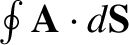 from the two faces normal to the
  -axis is
 |
(1.130) |
 is the volume element. (See Figure A.21.)
There are analogous contributions
from the sides normal to the
is the volume element. (See Figure A.21.)
There are analogous contributions
from the sides normal to the  - and
- and  -axes, so the total of all the contributions
is
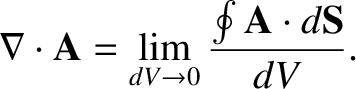
The divergence of a vector field is defined
-axes, so the total of all the contributions
is
The divergence of a vector field is defined
 |
(1.132) |
 with . The formal definition of
 is
is
 |
(1.133) |
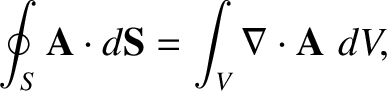
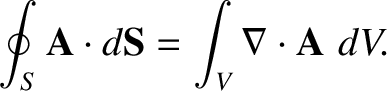
One of the most important results in vector field theory is the so-called
divergence theorem. This states that for any volume
 surrounded by a closed surface ,
 |
(1.134) |
is an outward pointing volume element.
The proof is very
straightforward. We divide up the volume into very many infinitesimal cubes, and
sum
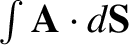 over all of the surfaces. The contributions
from the interior surfaces cancel out, leaving just the contribution from the outer
surface. (See Figure A.22.) We can use Equation (A.131) for each cube individually. This tells us that
the summation is equivalent to
over all of the surfaces. The contributions
from the interior surfaces cancel out, leaving just the contribution from the outer
surface. (See Figure A.22.) We can use Equation (A.131) for each cube individually. This tells us that
the summation is equivalent to
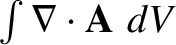 over the whole
volume. Thus, the integral of
over the whole
volume. Thus, the integral of
 over the outer surface is
equal to the integral of
over the whole volume, which
proves the divergence theorem.
over the outer surface is
equal to the integral of
over the whole volume, which
proves the divergence theorem.
Now, for a vector field with
 ,
,
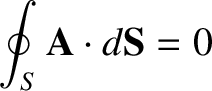 |
(1.135) |
. So, for two surfaces,
 and
and  , on the same rim,
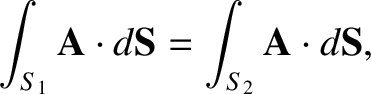 |
(1.136) |
has been reversed relative to those on the closed surface. Hence, the
sign of the associated surface integral is also reversed.)
Thus, if
then the surface integral depends on the rim, but
not on the nature of the surface that spans it.
On the other hand, if
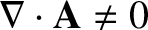 then the integral
depends on both the rim and the surface.
then the integral
depends on both the rim and the surface.
Consider an incompressible fluid whose velocity field is  . It is clear that
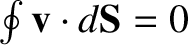 for any closed surface, because what flows into the
surface must flow out again. Thus, according to the divergence theorem,
for any closed surface, because what flows into the
surface must flow out again. Thus, according to the divergence theorem,
 for any volume. The only way in which this is
possible is if
for any volume. The only way in which this is
possible is if
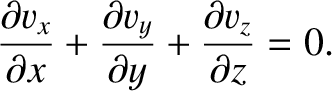
 is everywhere zero. Thus, the velocity components
of an incompressible fluid satisfy the following differential relation:
is everywhere zero. Thus, the velocity components
of an incompressible fluid satisfy the following differential relation:
 |
(1.137) |
It is sometimes helpful to represent a vector field by lines of force
or field-lines.
The direction of a line of force at any point is the same as the local direction of
. The density of lines (i.e., the number of lines crossing a unit surface
perpendicular to ) is equal to  .
For instance, in Figure A.24, is larger at point 1 than at point 2. The number of lines
crossing a surface element is
. So, the
net number of lines leaving a closed surface is
.
For instance, in Figure A.24, is larger at point 1 than at point 2. The number of lines
crossing a surface element is
. So, the
net number of lines leaving a closed surface is
 |
(1.138) |
then there is no net flux of lines out of any surface.
Such a field is
called a solenoidal vector field. The simplest example of a solenoidal vector
field is one in which the lines of force all form closed loops.
![\includegraphics[width=0.6\textwidth]{AppendixA/figA_21.eps}](img4818.png)

![\includegraphics[width=0.7\textwidth]{AppendixA/figA_22.eps}](img4829.png)
![\includegraphics[width=0.8\textwidth]{AppendixA/figA_23.eps}](img4833.png)
![\includegraphics[width=0.6\textwidth]{AppendixA/figA_24.eps}](img4840.png)