A burnt-out star is basically a gas of electrons and ions. As the star collapses, its density increases, and so the mean separation between its constituent particles decreases. Eventually, the mean separation becomes of order the de Broglie wavelength of the electrons, and the electron gas becomes degenerate. Note, that the de Broglie wavelength of the ions is much smaller than that of the electrons, so the ion gas remains non-degenerate. Now, even at zero temperature, a degenerate electron gas exerts a substantial pressure, because the Pauli exclusion principle prevents the mean electron separation from becoming significantly smaller than the typical de Broglie wavelength (see previous section). Thus, it is possible for a burnt-out star to maintain itself against complete collapse under gravity via the degeneracy pressure of its constituent electrons. Such stars are termed white-dwarfs. Let us investigate the physics of white-dwarfs in more detail.
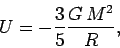
The total energy of a white-dwarf star can be written
 is the kinetic energy of the degenerate electrons (the kinetic
energy of the ion is negligible), and
is the kinetic energy of the degenerate electrons (the kinetic
energy of the ion is negligible), and  is the gravitational potential
energy. Let us assume, for the sake of simplicity, that the density of the
star is uniform. In this case, the gravitational potential
energy takes the form
is the gravitational potential
energy. Let us assume, for the sake of simplicity, that the density of the
star is uniform. In this case, the gravitational potential
energy takes the form
 is the gravitational constant,
  is the stellar mass, and
  is
the stellar radius.
is
the stellar radius.
From the previous subsection, the kinetic energy of a degenerate electron gas is simply
 is the number of electrons,
  the volume of the star, and
  the electron mass.
The interior of a white-dwarf star is composed of atoms like
 and
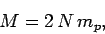
and  which contain equal numbers of protons, neutrons, and
electrons. Thus,
which contain equal numbers of protons, neutrons, and
electrons. Thus,
 is the proton mass.
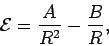
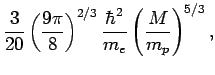
Equations (516)-(519) can be combined to give
 |
 |
 |
(521) |
 |
|
 |
(522) |
 , is that which
minimizes the total energy
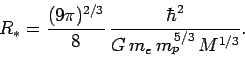
, is that which
minimizes the total energy  . In fact,
it is easily demonstrated that
. In fact,
it is easily demonstrated that
 |
(523) |
 |
(524) |
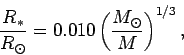
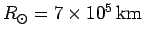 is the solar radius, and
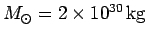 the solar mass. It follows that
the radius of a typical solar mass white-dwarf is about 7000km:
i.e., about the same as the radius of the Earth. The first
white-dwarf to be discovered (in 1862) was the companion of Sirius. Nowadays,
thousands of white-dwarfs have been observed, all with properties similar
to those described above.
the solar mass. It follows that
the radius of a typical solar mass white-dwarf is about 7000km:
i.e., about the same as the radius of the Earth. The first
white-dwarf to be discovered (in 1862) was the companion of Sirius. Nowadays,
thousands of white-dwarfs have been observed, all with properties similar
to those described above.
Note from Eqs. (518), (519), and (525)
that
 . In other words, the mean energy of the
electrons inside a white dwarf increases as the stellar mass increases.
Hence, for a sufficiently massive white dwarf, the electrons can become
relativistic. It turns out that the degeneracy pressure for
relativistic electrons only scales as
. In other words, the mean energy of the
electrons inside a white dwarf increases as the stellar mass increases.
Hence, for a sufficiently massive white dwarf, the electrons can become
relativistic. It turns out that the degeneracy pressure for
relativistic electrons only scales as  , rather that
  ,
and thus is unable to balance the gravitational pressure [which also
scales as --see Eq. (520)]. It follows that electron
degeneracy pressure is only able to halt the collapse of a burnt-out star
provided that the stellar mass does not exceed some critical value, known
as the Chandrasekhar limit,
which turns out to be about
,
and thus is unable to balance the gravitational pressure [which also
scales as --see Eq. (520)]. It follows that electron
degeneracy pressure is only able to halt the collapse of a burnt-out star
provided that the stellar mass does not exceed some critical value, known
as the Chandrasekhar limit,
which turns out to be about  times the mass of the Sun. Stars
whose mass exceeds the Chandrasekhar limit inevitably collapse to
produce extremely compact objects, such as neutron stars (which are
held up by the degeneracy pressure of their constituent neutrons),
or black holes.
times the mass of the Sun. Stars
whose mass exceeds the Chandrasekhar limit inevitably collapse to
produce extremely compact objects, such as neutron stars (which are
held up by the degeneracy pressure of their constituent neutrons),
or black holes.