Next: Exercises
Up: One-Dimensional Potentials
Previous: Square Potential Well
Simple Harmonic Oscillator
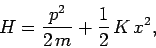
The classical Hamiltonian of a simple harmonic oscillator is
 |
(389) |
where  is the so-called force constant of the oscillator. Assuming that the quantum
mechanical Hamiltonian has the same form as the classical Hamiltonian, the time-independent Schrödinger equation for a particle of mass
is the so-called force constant of the oscillator. Assuming that the quantum
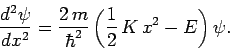
mechanical Hamiltonian has the same form as the classical Hamiltonian, the time-independent Schrödinger equation for a particle of mass  and energy
  moving in a
simple harmonic potential becomes
moving in a
simple harmonic potential becomes
 |
(390) |
Let
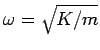 , where
  is the oscillator's classical angular frequency of oscillation. Furthermore, let
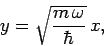 |
(391) |
and
 |
(392) |
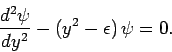
Equation (390) reduces to
 |
(393) |
We need to find solutions to the above equation which are bounded
at infinity: i.e., solutions which satisfy the boundary
condition
 as
as
 .
.
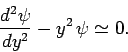
Consider the behavior of the solution to Eq. (393) in the limit  . As is easily seen, in this limit the equation simplifies somewhat to give
 |
(394) |
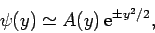
The approximate solutions to the above equation are
 |
(395) |
where  is a relatively slowly varying function of
  .
Clearly, if
.
Clearly, if  is to remain bounded as
then we
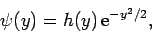
must chose the exponentially decaying solution. This suggests that
we should write
is to remain bounded as
then we
must chose the exponentially decaying solution. This suggests that
we should write
 |
(396) |
where we would expect  to be an algebraic, rather than an exponential, function of .
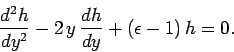
Substituting Eq. (396) into Eq. (393), we obtain
 |
(397) |
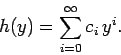
Let us attempt a power-law solution of the form
 |
(398) |
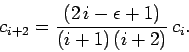
Inserting this test solution into Eq. (397), and equating the
coefficients of  , we obtain the recursion relation
 |
(399) |
Consider the behavior of in the limit
.
The above recursion relation simplifies to
 |
(400) |
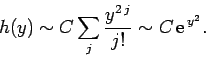
Hence, at large  , when the higher powers of dominate, we
have
, when the higher powers of dominate, we
have
 |
(401) |
It follows that
 varies as
 as
. This behavior is unacceptable,
since it does not satisfy the boundary condition
as
. The only way in which we can prevent
as
. This behavior is unacceptable,
since it does not satisfy the boundary condition
as
. The only way in which we can prevent  from blowing up as
is to demand that the power series (398) terminate at
some finite value of
from blowing up as
is to demand that the power series (398) terminate at
some finite value of  . This implies, from the recursion relation
(399), that
. This implies, from the recursion relation
(399), that
 |
(402) |
where  is a non-negative integer. Note that the number of terms in the power
series (398) is
is a non-negative integer. Note that the number of terms in the power
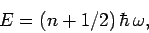
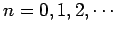
series (398) is  . Finally, using Eq. (392), we obtain
 |
(403) |
for
 .
.
Hence, we conclude that a particle moving in a
harmonic potential has quantized energy levels which
are equally spaced. The
spacing between successive energy levels is  , where
is the classical oscillation frequency. Furthermore, the
lowest energy state (
, where
is the classical oscillation frequency. Furthermore, the
lowest energy state ( ) possesses the finite energy
 . This is sometimes called zero-point energy.
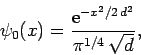
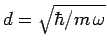
It is easily demonstrated that the (normalized) wavefunction of the lowest
energy state takes the form
. This is sometimes called zero-point energy.
It is easily demonstrated that the (normalized) wavefunction of the lowest
energy state takes the form
 |
(404) |
where
 .
.
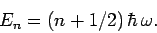
Let  be an energy eigenstate of the harmonic oscillator
corresponding to the eigenvalue
be an energy eigenstate of the harmonic oscillator
corresponding to the eigenvalue
 |
(405) |
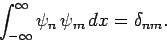
Assuming that the  are properly normalized (and real), we have
 |
(406) |
Now, Eq. (393) can be written
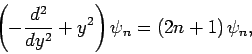 |
(407) |
where  , and
. It is helpful to
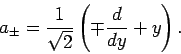
define the operators
, and
. It is helpful to
define the operators
 |
(408) |
As is easily demonstrated, these operators satisfy the commutation relation
![\begin{displaymath}[a_+,a_-]= -1.
\end{displaymath}](img1034.png) |
(409) |
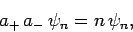
Using these operators, Eq. (407) can also be written
in the forms
 |
(410) |
or
 |
(411) |
The above two equations imply that
We conclude that  and
and  are raising and lowering operators,
respectively, for the harmonic oscillator: i.e., operating on the wavefunction with causes the
quantum number to increase by unity, and vice versa.
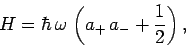
The Hamiltonian for the harmonic oscillator can be written in the form
are raising and lowering operators,
respectively, for the harmonic oscillator: i.e., operating on the wavefunction with causes the
quantum number to increase by unity, and vice versa.
The Hamiltonian for the harmonic oscillator can be written in the form
 |
(414) |
from which the result
 |
(415) |
is readily deduced.
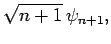
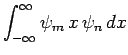
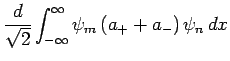
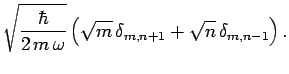
Finally, Eqs. (406), (412), and (413)
yield the useful expression
Subsections
Next: Exercises
Up: One-Dimensional Potentials
Previous: Square Potential Well
Richard Fitzpatrick
2010-07-20