


 and energy
  , moving in the positive
  -direction, can be written
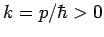 and
and
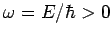 . Here,
  and
and
 are linked via the dispersion relation (79). Expression (82) represents a plane wave whose maxima and
minima propagate in the positive -direction
with the phase velocity
are linked via the dispersion relation (79). Expression (82) represents a plane wave whose maxima and
minima propagate in the positive -direction
with the phase velocity  . As we have seen, this phase velocity is only half of the classical velocity of a massive particle.
From before, the most reasonable physical interpretation of the wavefunction is that
 is proportional to the probability density of finding the particle
at position at time
is proportional to the probability density of finding the particle
at position at time  . However, the modulus squared of the wavefunction (82) is
 , which depends on neither nor . In other words, this wavefunction represents a particle
which is equally likely to be found anywhere on the -axis at all times.
Hence, the fact that the maxima and minima of the wavefunction propagate at
a phase velocity which does not correspond to the classical particle velocity does not have any real physical consequences.
, which depends on neither nor . In other words, this wavefunction represents a particle
which is equally likely to be found anywhere on the -axis at all times.
Hence, the fact that the maxima and minima of the wavefunction propagate at
a phase velocity which does not correspond to the classical particle velocity does not have any real physical consequences.
So, how can we write the wavefunction of a particle which is localized
in : i.e., a particle which is more likely to be found at some
positions on the -axis than at others? It turns out that we can achieve this goal by forming
a linear combination of plane waves of different wavenumbers:
i.e.,
 represents the complex amplitude of plane waves of wavenumber in this combination. In writing the above expression,
we are relying on the assumption that particle waves are superposable:
i.e., it is possible to add two valid wave solutions to form a third valid wave solution.
The ultimate justification for this assumption is that particle waves
satisfy a differential wave equation which is linear in
represents the complex amplitude of plane waves of wavenumber in this combination. In writing the above expression,
we are relying on the assumption that particle waves are superposable:
i.e., it is possible to add two valid wave solutions to form a third valid wave solution.
The ultimate justification for this assumption is that particle waves
satisfy a differential wave equation which is linear in  . As we
shall see, in Sect. 3.15, this is indeed the case. Incidentally, a plane wave which varies as
. As we
shall see, in Sect. 3.15, this is indeed the case. Incidentally, a plane wave which varies as
![$\exp[{\rm i} (k x-\omega t)]$](img321.png) and has a negative (but positive ) propagates
in the negative -direction at the phase velocity
and has a negative (but positive ) propagates
in the negative -direction at the phase velocity  . Hence, the superposition (83)
includes both forward and backward propagating waves.
. Hence, the superposition (83)
includes both forward and backward propagating waves.
Now, there is a useful mathematical theorem, known as Fourier's theorem, which states that if
 is known as the Fourier transform of the
function
is known as the Fourier transform of the
function  . We can use Fourier's theorem to find the -space function which generates any given -space wavefunction
  at a given time.
For instance, suppose that at  the wavefunction of our particle takes the
form
the wavefunction of our particle takes the
form
 , and very
unlikely to yield a value which differs from by more than
, and very
unlikely to yield a value which differs from by more than
 . Thus, (86) is the wavefunction of a particle
which is initially localized around
. Thus, (86) is the wavefunction of a particle
which is initially localized around  in some region whose width is
of order
in some region whose width is
of order
 . This type of wavefunction is
known as a wave packet.
. This type of wavefunction is
known as a wave packet.
Now, according to Eq. (83),
 |
(88) |
![\begin{displaymath}
\bar{\psi}(k) \propto
{\rm e}^{-{\rm i} (k-k_0) x_0}\int_{...
...0) (x-x_0) - \frac{(x-x_0)^2}{4 ({\mit\Delta}x)^2}\right]dx.
\end{displaymath}](img337.png) |
(90) |
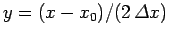 , this reduces to
![\begin{displaymath}
\bar{\psi}(k) \propto {\rm e}^{-{\rm i} k x_0}
\int_{-\infty}^{\infty}\exp\left[-{\rm i} \beta y - y^2\right] dy,
\end{displaymath}](img339.png) |
(91) |
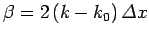 . The above equation
can be rearranged to give
. The above equation
can be rearranged to give
 |
(92) |
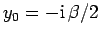 . The integral now just reduces to a number,
as can easily be seen by making the change of variable
. The integral now just reduces to a number,
as can easily be seen by making the change of variable  .
Hence, we obtain
.
Hence, we obtain
 |
(94) |
Now, if
 is proportional to the probability density of a measurement of the
particle's position yielding the value then it stands to reason that
is proportional to the probability density of a measurement of the
particle's position yielding the value then it stands to reason that
 is proportional to the probability density of a measurement of the
particle's wavenumber yielding the value . (Recall that
is proportional to the probability density of a measurement of the
particle's wavenumber yielding the value . (Recall that  ,
so a measurement of the particle's wavenumber, , is equivalent to a measurement of the particle's
momentum, ). According to Eq. (93),
,
so a measurement of the particle's wavenumber, , is equivalent to a measurement of the particle's
momentum, ). According to Eq. (93),
-space. See
Eq. (87) and Fig. 7. Hence, a measurement of is
most likely to yield the value  , and very unlikely to yield
a value which differs from by more than
, and very unlikely to yield
a value which differs from by more than
 . Incidentally, a Gaussian is the only mathematical function
in -space which has the same form as its Fourier transform in -space.
. Incidentally, a Gaussian is the only mathematical function
in -space which has the same form as its Fourier transform in -space.
We have just seen that a Gaussian probability distribution of characteristic
width
in -space [see Eq. (87)] transforms to a Gaussian probability distribution of characteristic width
 in -space [see Eq. (95)],
where
in -space [see Eq. (95)],
where
 |
(96) |
-space (i.e., if is small) then we need
to combine plane waves with a very wide range of different -values
(i.e., will be large). Conversely, if we only combine
plane waves whose wavenumbers differ by a small amount (i.e., if
is small) then the resulting wave packet will be very
extended in -space (i.e., will be large).


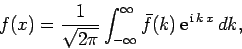

![\begin{displaymath}
\psi(x,0) \propto \exp\left[{\rm i} k_0 x - \frac{(x-x_0)^{ 2}}{4 ({\mit\Delta}x)^{ 2}}\right].
\end{displaymath}](img328.png)
![\begin{displaymath}
\vert\psi(x,0)\vert^{ 2} \propto \exp\left[- \frac{(x-x_0)^{ 2}}{2 ({\mit\Delta}x)^{ 2}}\right].
\end{displaymath}](img329.png)
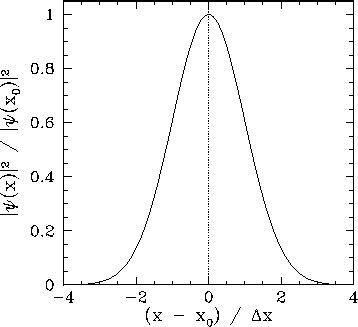

![\begin{displaymath}
\bar{\psi}(k) \propto \exp\left[-{\rm i} k x_0 - \frac{(k-k_0)^{ 2}}{4 ({\mit\Delta}k)^2}\right],
\end{displaymath}](img344.png)
![\begin{displaymath}
\vert\bar{\psi}(k)\vert^{ 2} \propto \exp\left[- \frac{(k-k_0)^{ 2}}{2 ({\mit\Delta}k)^{ 2}}\right].
\end{displaymath}](img349.png)