


Next: Partial Waves
Up: Scattering Theory
Previous: Fundamentals
Equation (1266) is not particularly useful, as it stands, because
the quantity
 depends on the, as yet, unknown wavefunction
 [see Eq. (1261)]. Suppose, however, that the scattering is
not particularly strong. In this case, it is reasonable to suppose that the total
wavefunction, , does not differ substantially from the
incident wavefunction,
[see Eq. (1261)]. Suppose, however, that the scattering is
not particularly strong. In this case, it is reasonable to suppose that the total
wavefunction, , does not differ substantially from the
incident wavefunction,
 . Thus, we can
obtain an expression for
by making the
substitution
. Thus, we can
obtain an expression for
by making the
substitution
 in Eq. (1261). This procedure is called
the Born approximation.
in Eq. (1261). This procedure is called
the Born approximation.
The Born approximation yields
 |
(1267) |
Thus,
is proportional to the Fourier transform of the scattering potential  with respect to the wavevector
 .
.
For a spherically symmetric potential,
 |
(1268) |
giving
 |
(1269) |
Note that
 is just a function of
  for a
spherically symmetric potential.
It is easily demonstrated that
for a
spherically symmetric potential.
It is easily demonstrated that
 |
(1270) |
where  is the angle subtended between the vectors
 and
and  . In other words, is the scattering angle. Recall that the
vectors and have the same length, via energy conservation.
. In other words, is the scattering angle. Recall that the
vectors and have the same length, via energy conservation.
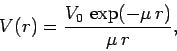
Consider scattering by a Yukawa potential
 |
(1271) |
where  is a constant, and
  measures the ``range'' of the
potential. It follows from Eq. (1269) that
measures the ``range'' of the
potential. It follows from Eq. (1269) that
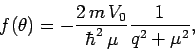 |
(1272) |
since
 |
(1273) |
Thus, in the Born approximation, the differential cross-section
for scattering by a Yukawa potential is
![\begin{displaymath}
\frac{d\sigma}{d \Omega} \simeq \left(\frac{2 m V_0}{ \hb...
...u}\right)^2
\frac{1}{[2 k^2 (1-\cos\theta) + \mu^2]^{ 2}},
\end{displaymath}](img2886.png) |
(1274) |
given that
 |
(1275) |
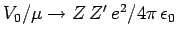
The Yukawa potential reduces to the familiar Coulomb potential as
 , provided that
 . In this limit, the Born differential cross-section becomes
 |
(1276) |
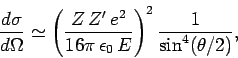
Recall that  is equivalent to
  , so the above
equation can be rewritten
, so the above
equation can be rewritten
 |
(1277) |
where 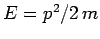 is the kinetic energy of the incident particles.
Of course, Eq. (1277) is the famous Rutherford scattering cross-section formula.
is the kinetic energy of the incident particles.
Of course, Eq. (1277) is the famous Rutherford scattering cross-section formula.
The Born approximation is valid provided that is
not too different from
in the scattering region.
It follows, from Eq. (1258), that the condition for
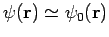 in the vicinity of
 is
is
 |
(1278) |
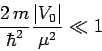
Consider the special case of the Yukawa potential. At low energies,
(i.e.,  ) we can replace
 by unity,
giving
by unity,
giving
 |
(1279) |
as the condition for the validity of the Born approximation.
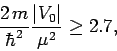
The condition for the Yukawa potential to develop a bound state
is
 |
(1280) |
where is negative. Thus, if the potential is strong enough to
form a bound state then the Born approximation is likely to break
down. In the high- limit, Eq. (1278) yields
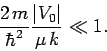 |
(1281) |
This inequality becomes progressively easier to satisfy as increases,
implying that the Born approximation is more accurate at high
incident particle energies.
Next: Partial Waves
Up: Scattering Theory
Previous: Fundamentals
Richard Fitzpatrick
2010-07-20