


Next: Uncertainty Relation
Up: Position and Momentum
Previous: Generalized Schrödinger Representation
Consider a system with one degree of freedom, describable in terms of a coordinate
 and its conjugate momentum
  , both of which have a continuous range of
eigenvalues. We have seen that it is possible to represent the system in terms
of the eigenkets of
.
This is termed the Schrödinger representation.
However, it is also possible to represent the system in
terms of the eigenkets of
.
, both of which have a continuous range of
eigenvalues. We have seen that it is possible to represent the system in terms
of the eigenkets of
.
This is termed the Schrödinger representation.
However, it is also possible to represent the system in
terms of the eigenkets of
.
Consider the eigenkets of
which belong to the eigenvalues  . These are
denoted
. These are
denoted
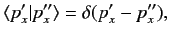
 . The orthogonality relation for the momentum eigenkets is
 |
(171) |
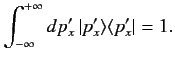
and the corresponding completeness relation is
 |
(172) |
A general state ket can be written
 |
(173) |
where the standard ket  satisfies
 |
(174) |
Note that the standard ket in this representation is quite
different to that in the Schrödinger representation.
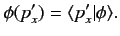
The momentum space wavefunction
 satisfies
 |
(175) |
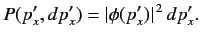
The probability that a measurement of the momentum yields a result
lying in the range
to
 is given by
 |
(176) |
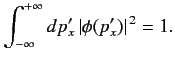
Finally, the normalization condition for a physical momentum space wavefunction is
 |
(177) |
The fundamental commutation relations (114)-(116) exhibit a
particular symmetry between coordinates and their conjugate momenta. If all the
coordinates are transformed into their conjugate momenta, and vice versa, and
 is then replaced by
  , then the commutation relations are
unchanged. It follows from this symmetry that we can always choose the eigenkets
of
in such a manner that the coordinate
can be represented as (see Section 2.4)
, then the commutation relations are
unchanged. It follows from this symmetry that we can always choose the eigenkets
of
in such a manner that the coordinate
can be represented as (see Section 2.4)
 |
(178) |
This is termed the momentum representation.
The above result is easily generalized to a system with more than one degree of
freedom. Suppose the system is specified by  coordinates,
 , and
conjugate momenta,
, and
conjugate momenta,
 . Then, in the momentum representation, the
coordinates can be written as
. Then, in the momentum representation, the
coordinates can be written as
 |
(179) |
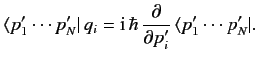
We also have
 |
(180) |
and
 |
(181) |
The momentum representation is less useful than the Schrödinger representation
for a very simple reason. The energy operator (i.e., the Hamiltonian) of
most simple systems takes the form of a sum of quadratic terms in the momenta
(i.e., the kinetic energy) plus a complicated function of the coordinates
(i.e., the potential energy). In the Schrödinger representation,
the eigenvalue problem for the energy translates into a second-order differential
equation in the coordinates, with a complicated potential function. In the
momentum representation, the problem transforms into a high-order differential
equation in the momenta, with a quadratic potential. With the mathematical
tools at our disposal, we are far better able to solve the former type of problem
than the latter. Hence, the Schrödinger representation is
generally more useful than the momentum representation.
Next: Uncertainty Relation
Up: Position and Momentum
Previous: Generalized Schrödinger Representation
Richard Fitzpatrick
2013-04-08