


Next: Waves in Warm Plasmas Up: Waves in Inhomogeneous Plasmas Previous: Ionospheric Radio Wave Propagation Contents
 , in a linear dielectric medium is related to the electric field-strength,
  ,
according to
,
according to

 is the refractive index. Any divergence of the polarization field is associated with a bound charge density

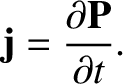
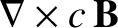
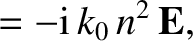
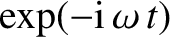 time variation of the wave fields, demonstrate from Maxwell's equations that
 |
 |
|
 |
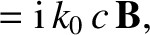 |
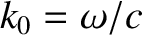 .
.
 -direction, that propagates in the
  -direction through
a medium of refractive index
-direction through
a medium of refractive index  . Assuming that
 |
 |
|
 |
 |
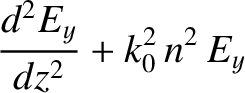 |
 |
|
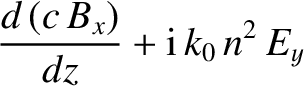 |
|
.
-direction, that propagates in the  - plane
through a medium of refractive index . Assuming that
- plane
through a medium of refractive index . Assuming that
|
 |
|
|
 |
 |
|
|
 |
|
 , and
.
, and
.
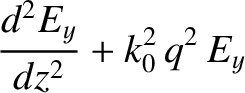
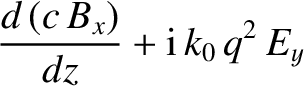
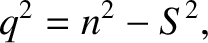
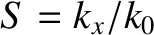
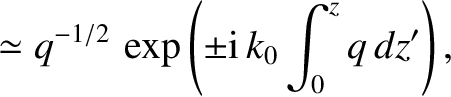
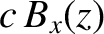
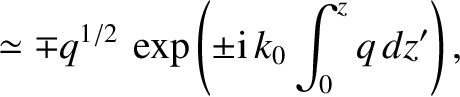
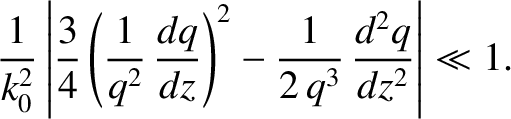
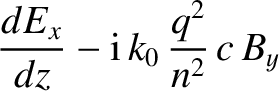
Show that the WKB solutions take the form
 |
 |
|
 |
 |
--plane, that propagates in the - plane
through a medium of refractive index . Assuming that
|
 |
|
|
 |
 |
|
|
 |
|
, and
.
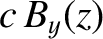
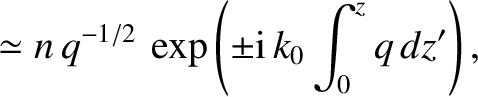
Show that the WKB solutions take the form
 |
 |
|
 |
 |
![$\displaystyle \frac{1}{k_0^{2}}\left\vert\frac{3}{4}\left(\frac{1}{q^2}\,\frac{...
...2n}{dz^2}-2\,\left(\frac{1}{n}\,\frac{dn}{dz}\right)^2\right]\right\vert\ll 1.
$](img2199.png)
 is launched vertically from ground level, travels upward into the ionosphere,
is reflected, and returns to ground level. If
is launched vertically from ground level, travels upward into the ionosphere,
is reflected, and returns to ground level. If
 is the net travel time of the pulse then the so-called
equivalent height of reflection is defined
is the net travel time of the pulse then the so-called
equivalent height of reflection is defined
 . It follows that
  is the altitude of the reflection
layer calculated on the assumption that the pulse always travels at the velocity of light in vacuum. Let
is the altitude of the reflection
layer calculated on the assumption that the pulse always travels at the velocity of light in vacuum. Let
 be the
ionospheric plasma frequency, where measures altitude above the ground. Neglect collisions and the Earth's magnetic field.
be the
ionospheric plasma frequency, where measures altitude above the ground. Neglect collisions and the Earth's magnetic field.
![$\displaystyle h(\omega) = \int_0^{z_0(\omega)}\frac{\omega}{\left[\omega^2- {\mit\Pi}_e^{2}(z)\right]^{1/2}}\,dz,
$](img2203.png)
 .
.
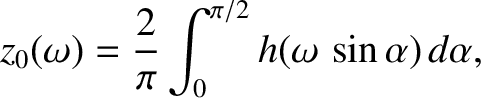
 is a monotonically increasing function of then the previous integral can be inverted to
give
is a monotonically increasing function of then the previous integral can be inverted to
give

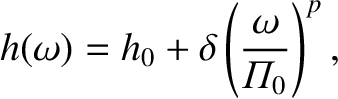
 ,
,  , and
, and
 are positive constants, then
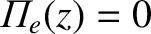 for
for  , and
, and
![$\displaystyle {\mit\Pi}_e(z) =\left[\frac{\pi\,{\Gamma}(1+p)}{{\Gamma}(1/2+p/2)...
.../2)}\right]^{1/p} \frac{{\mit\Pi}_0}{2}\left(\frac{z-h_0}{\delta}\right)^{1/p}
$](img2213.png)
 . Here,
 is a gamma function (Abramowitz and Stegun 1965).
, of the ionosphere is given by
 for ,
and
for ,
and  for , where
  and are positive constants, and the Earth's magnetic field and curvature are both neglected.
Here, measures altitude above the Earth's surface.
and are positive constants, and the Earth's magnetic field and curvature are both neglected.
Here, measures altitude above the Earth's surface.
 to the vertical. Show that the packet returns to Earth a
distance
to the vertical. Show that the packet returns to Earth a
distance
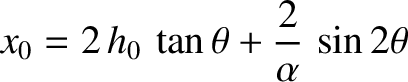
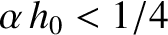 then for some values of
  the previous equation is satisfied
by three different values of . In other words, wave packets can travel from the transmitter to the receiver via one of
three different paths. Show that the critical case
the previous equation is satisfied
by three different values of . In other words, wave packets can travel from the transmitter to the receiver via one of
three different paths. Show that the critical case
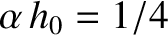 corresponds to
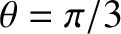 and
and
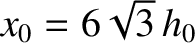 .
.
 from the transmitter, provided that
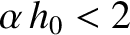 .
.