


 is a
function of
is a
function of  . Demonstrate that the associated
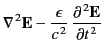
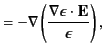
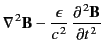
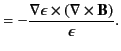
wave equations take the form
. Demonstrate that the associated
wave equations take the form
 |
 |
|
 |
 |
 at the Brewster angle. Demonstrate that the refracted ray
is also incident on the rear (glass/air) interface of the pane at the Brewster
angle.
at the Brewster angle. Demonstrate that the refracted ray
is also incident on the rear (glass/air) interface of the pane at the Brewster
angle.
 and
and  . Find the coefficients of reflection and transmission
as functions of the angle of incidence for the wave polarizations in
which all electric fields are parallel to the boundary and all magnetic
fields are parallel to the boundary. Is there a Brewster angle? If so, what is it?
Is it possible to obtain total reflection? If so, what is the critical angle of
incidence required to obtain total reflection?
. Find the coefficients of reflection and transmission
as functions of the angle of incidence for the wave polarizations in
which all electric fields are parallel to the boundary and all magnetic
fields are parallel to the boundary. Is there a Brewster angle? If so, what is it?
Is it possible to obtain total reflection? If so, what is the critical angle of
incidence required to obtain total reflection?
 at all wave
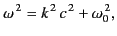
frequencies. Demonstrate that the dispersion relation for
electromagnetic waves takes the form
at all wave
frequencies. Demonstrate that the dispersion relation for
electromagnetic waves takes the form
where
 is a constant.
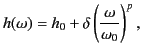
where
 ,
,  , and
are positive constants, then
, and
are positive constants, then
 for
for  , and
, and
![$\displaystyle \omega_p(z) =\left[\frac{\pi\,{\mit\Gamma}(1+p)}{{\mit\Gamma}(1/2...
...2+p/2)}\right]^{1/p} \frac{\omega_0}{2}\left(\frac{z-h_0}{\delta}\right)^{1/p}
$](img2585.png)
for
 . Here,
 is a Gamma function.
 , of the ionosphere is given by
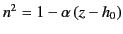 for
,
and
for
,
and  for
, where
for
, where  and
are positive constants, and the Earth's magnetic field and curvature are both neglected.
Here,
and
are positive constants, and the Earth's magnetic field and curvature are both neglected.
Here,  measures altitude above the Earth's surface.
 to the vertical. Show that the packet returns to Earth a
distance
to the vertical. Show that the packet returns to Earth a
distance
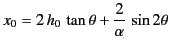
from the transmitter. Demonstrate that if
 then for some values of
  the previous equation is satisfied
by three different values of
. In other words, wave packets can travel from the transmitter to the receiver via one of
three different paths. Show that the critical case
the previous equation is satisfied
by three different values of
. In other words, wave packets can travel from the transmitter to the receiver via one of
three different paths. Show that the critical case
 corresponds to
 and
and
 .
.
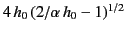 from the transmitter, provided that
 .
.