degree of freedom dynamical system described by the
generalized coordinates
degree of freedom dynamical system described by the
generalized coordinates  , for
, for  . Suppose that the
kinetic energy
. Suppose that the
kinetic energy  and the potential energy
  are not explicit
functions of time. This implies that the system in question
is isolated: i.e., it is not subject to any external forces or
time-varying constraints. In virtually all dynamical systems of interest, the kinetic
energy can be expressed as a quadratic form: i.e.,
are not explicit
functions of time. This implies that the system in question
is isolated: i.e., it is not subject to any external forces or
time-varying constraints. In virtually all dynamical systems of interest, the kinetic
energy can be expressed as a quadratic form: i.e.,
 in the above form are
invariant under interchange of the indices
in the above form are
invariant under interchange of the indices  and
and  : i.e.,
 |
(771) |
 .
.
Suppose that  , for , corresponds to an
equilibrium state of the system. It follows that
and
, for , corresponds to an
equilibrium state of the system. It follows that
and
 , for , should be a possible solution of the equations of motion.
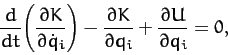
Now, Lagrange's equations of motion for the system take the form [see
Equation (613)]
, for , should be a possible solution of the equations of motion.
Now, Lagrange's equations of motion for the system take the form [see
Equation (613)]
. Here, we have made use of the definition  , and
the fact that is independent of the
, and
the fact that is independent of the  . Now, it is clear, from
an examination of Equation (770), that every component making up
the first two terms in the above equation contains either a
. Now, it is clear, from
an examination of Equation (770), that every component making up
the first two terms in the above equation contains either a  or
a
or
a  , for some . But, we can set all of the generalized velocities
and accelerations to zero in an equilibrium state of the system.
Hence, the first two terms in the above equation are zero, and the
condition for equilibrium reduces to
. In other words, , for , is an equilibrium
state provided that all of the generalized forces,
, for some . But, we can set all of the generalized velocities
and accelerations to zero in an equilibrium state of the system.
Hence, the first two terms in the above equation are zero, and the
condition for equilibrium reduces to
. In other words, , for , is an equilibrium
state provided that all of the generalized forces,  [see Equation (599)], evaluated at ,
are zero. Let us suppose that this is the case.
[see Equation (599)], evaluated at ,
are zero. Let us suppose that this is the case.