, defined in Section 8.3, takes the form of a real symmetric three-dimensional
matrix. It therefore follows, from the matrix theory that we have just reviewed,
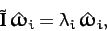
that the moment of inertia tensor possesses three mutually orthogonal eigenvectors which are associated with three real eigenvalues. Let the
, defined in Section 8.3, takes the form of a real symmetric three-dimensional
matrix. It therefore follows, from the matrix theory that we have just reviewed,
that the moment of inertia tensor possesses three mutually orthogonal eigenvectors which are associated with three real eigenvalues. Let the  th eigenvector (which can be normalized to
be a unit vector) be denoted
th eigenvector (which can be normalized to
be a unit vector) be denoted
 , and the th eigenvalue
  . It then
follows that
. It then
follows that
 .
.
The directions of the three mutually orthogonal unit vectors
define the three so-called principal axes
of rotation of the rigid body under investigation. These axes are special because when the body rotates about
one of them (i.e., when  is parallel to one of them) the angular momentum vector
  becomes parallel to the angular velocity vector .
This can be seen from a comparison of Equation (466) and Equation (487).
becomes parallel to the angular velocity vector .
This can be seen from a comparison of Equation (466) and Equation (487).
Suppose that we reorient our Cartesian coordinate
axes so the they coincide with the mutually orthogonal principal axes of rotation. In this new reference frame, the eigenvectors of are the unit vectors,
 ,
,  , and
, and  , and the eigenvalues
are the moments of inertia about these axes,
, and the eigenvalues
are the moments of inertia about these axes,  ,
,  , and
, and  , respectively. These latter quantities are referred to as the
principal moments of inertia.
Note that the products of inertia are all zero in the new
reference frame. Hence, in this frame, the moment
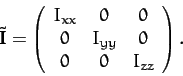
of inertia tensor takes the form of a diagonal matrix: i.e.,
, respectively. These latter quantities are referred to as the
principal moments of inertia.
Note that the products of inertia are all zero in the new
reference frame. Hence, in this frame, the moment
of inertia tensor takes the form of a diagonal matrix: i.e.,
 |
(488) |
, , and are indeed
the eigenvectors of the above matrix, with the eigenvalues , , and , respectively, and that
 is indeed parallel to whenever
is directed along , , or .
is indeed parallel to whenever
is directed along , , or .
When expressed in our new coordinate system, Equation (466)
yields
 |
(489) |
 |
(490) |
In conclusion, there are many great simplifications to be had by choosing a coordinate system whose axes coincide with the principal axes of rotation of the rigid body under investigation. But how do we determine the directions of the principal axes in practice?
Well, in general, we have to solve the eigenvalue equation
 |
(491) |
 , and
, and
 . Here,
  is the angle the unit eigenvector subtends with the
  -axis,
  the angle it
subtends with the
the angle it
subtends with the  -axis, and
  the angle it subtends with the
  -axis. Unfortunately, the analytic solution of the above matrix equation
is generally quite difficult.
-axis. Unfortunately, the analytic solution of the above matrix equation
is generally quite difficult.
Fortunately, however, in many instances the rigid body under investigation possesses some kind of symmetry, so that at least one principal axis can be found by inspection. In this case, the other two principal axes can be determined as follows.
Suppose that the -axis is known to be a principal axes (at the origin)
in some coordinate system. It follows that the two products of inertia  and
and  are zero [otherwise,
  would not be an eigenvector in Equation (492)]. The other two principal axes must lie in the
- plane: i.e.,
would not be an eigenvector in Equation (492)]. The other two principal axes must lie in the
- plane: i.e.,  . It then follows that
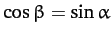 , since
.
The first two rows in the matrix equation (492) thus
reduce to
, since
.
The first two rows in the matrix equation (492) thus
reduce to
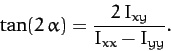
 between the above two equations, we obtain
 . Hence, Equation (495) yields
, lying between
. Hence, Equation (495) yields
, lying between  and
and  , which
satisfy the above equation. These specify the angles, , that
the two mutually orthogonal principal axes lying in the - plane
make with the -axis. Hence, we have now determined the directions of
all three principal axes. Incidentally, once we have determined the orientation angle, , of a principal axis,
we can then substitute back into Equation (493) to obtain the corresponding
principal moment of inertia, .
, which
satisfy the above equation. These specify the angles, , that
the two mutually orthogonal principal axes lying in the - plane
make with the -axis. Hence, we have now determined the directions of
all three principal axes. Incidentally, once we have determined the orientation angle, , of a principal axis,
we can then substitute back into Equation (493) to obtain the corresponding
principal moment of inertia, .
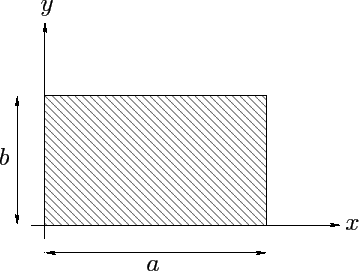
As an example, consider a uniform rectangular lamina of mass  and sides
  and
and  which lies
in the - plane, as shown in Figure 29. Suppose that the axis of
rotation passes through the origin (i.e., through a corner of the lamina).
Since
which lies
in the - plane, as shown in Figure 29. Suppose that the axis of
rotation passes through the origin (i.e., through a corner of the lamina).
Since  throughout the lamina, it follows from Equations (464) and
(465) that
throughout the lamina, it follows from Equations (464) and
(465) that
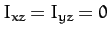 . Hence, the -axis
is a principal axis. After some straightforward integration, Equations (460)-(463) yield
. Hence, the -axis
is a principal axis. After some straightforward integration, Equations (460)-(463) yield
 |
 |
 |
(497) |
 |
|
 |
(498) |
 |
|
 |
(499) |
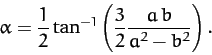 |
(500) |
- plane.
For the special case where  , we get
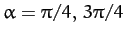 : i.e., the two in-plane principal axes of a square lamina (at a corner) are parallel to the two diagonals of the
lamina.
: i.e., the two in-plane principal axes of a square lamina (at a corner) are parallel to the two diagonals of the
lamina.