Next: Foucault Pendulum
Up: Rotating Reference Frames
Previous: Centrifugal Acceleration
We have now accounted for the first fictitious force,
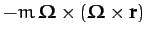 , in Equation (414).
Let us now investigate the second, which takes the form
, in Equation (414).
Let us now investigate the second, which takes the form
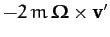 , and is called the Coriolis force.
Obviously, this force only affects objects which are moving in the rotating
reference frame.
, and is called the Coriolis force.
Obviously, this force only affects objects which are moving in the rotating
reference frame.
Consider a particle of mass  free-falling under gravity in our rotating reference frame. As before, we define Cartesian axes in the rotating frame such that the
  -axis
points vertically upward, and the
-axis
points vertically upward, and the  - and
- and  -axes are horizontal, with
the -axis pointing directly northward, and the -axis pointing directly
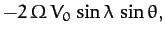
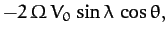
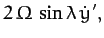
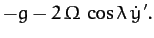
westward. It follows, from Equation (414), that the Cartesian equations of motion of the particle
in the rotating reference frame take the form:
-axes are horizontal, with
the -axis pointing directly northward, and the -axis pointing directly
westward. It follows, from Equation (414), that the Cartesian equations of motion of the particle
in the rotating reference frame take the form:
Here,
 , and
, and  is the local acceleration due to gravity. In the
above, we have neglected the centrifugal acceleration, for the sake
of simplicity. This is reasonable, since the only effect of the centrifugal
acceleration is to slightly modify the magnitude and direction of the
local gravitational acceleration. We have also neglected air resistance,
which is less reasonable.
is the local acceleration due to gravity. In the
above, we have neglected the centrifugal acceleration, for the sake
of simplicity. This is reasonable, since the only effect of the centrifugal
acceleration is to slightly modify the magnitude and direction of the
local gravitational acceleration. We have also neglected air resistance,
which is less reasonable.
Consider a particle which is dropped (at  ) from rest a height
  above the Earth's
surface. The following solution method exploits the fact that the
Coriolis force is much smaller in magnitude that the force of gravity: hence,
above the Earth's
surface. The following solution method exploits the fact that the
Coriolis force is much smaller in magnitude that the force of gravity: hence,
 can be treated as a small parameter.
To lowest order (i.e., neglecting ), the
particle's vertical motion satisfies
can be treated as a small parameter.
To lowest order (i.e., neglecting ), the
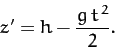
particle's vertical motion satisfies  , which can be solved,
subject to the initial conditions, to give
, which can be solved,
subject to the initial conditions, to give
 |
(427) |
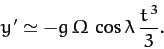
Substituting this expression into Equations (424) and (425),
neglecting terms involving
 , and solving subject to the
initial conditions, we obtain
, and solving subject to the
initial conditions, we obtain
 , and
, and
 |
(428) |
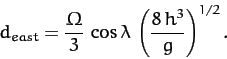
In other words, the particle is deflected eastward (i.e., in the negative
-direction). Now, the particle hits the ground when
 . Hence, the net eastward deflection of the particle as strikes the ground is
 |
(429) |
Note that this deflection is in the same direction as the Earth's rotation (i.e., west to east),
and is greatest at the equator, and zero at the poles.
A particle dropped from a height of 100m at the equator is deflected by about
 .
.
Consider a particle launched horizontally with some fairly large velocity
 |
(430) |
Here,  is the compass
bearing of the velocity vector (so north is
is the compass
bearing of the velocity vector (so north is  , east is
  , etc.). Neglecting any vertical motion, Equations (424) and (425) yield
which can be integrated to give
To lowest order in , the above equations are equivalent to
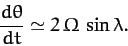
If follows that the Coriolis force causes the compass
bearing of the particle's velocity vector to rotate steadily as time progresses. The rotation rate is
 |
(437) |
Hence, the rotation is clockwise (looking from above) in the
northern hemisphere, and counter-clockwise in the
southern hemisphere. The rotation rate is zero at the equator, and
greatest at the poles.
The Coriolis force has a significant effect on terrestrial weather patterns.
Near equatorial regions, the intense heating of the Earth's surface due to the Sun results in hot
air rising. In the northern hemisphere, this causes cooler air to
move in a southerly direction toward the equator. The Coriolis
force deflects this moving air in a clockwise sense (looking from above),
resulting in the trade winds, which blow toward the southwest.
In the southern hemisphere, the cooler air moves northward, and
is deflected by the Coriolis force in a counter-clockwise sense, resulting
in trade winds which blow toward the northwest.
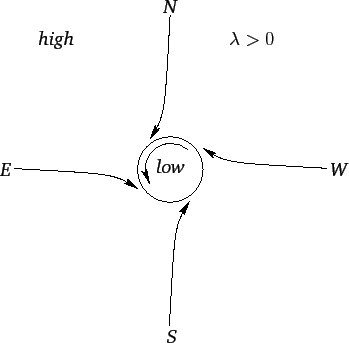
Furthermore, as air flows from high to low pressure regions,
the Coriolis force deflects the air in a clockwise/counter-clockwise manner in the northern/southern
hemisphere, producing cyclonic rotation--see Figure 26.
It follows that cyclonic rotation is counter-clockwise in the northern hemisphere,
and clockwise in the southern hemisphere. Thus, this
is the direction of rotation of tropical storms (e.g., hurricanes,
typhoons) in each hemisphere.
Figure 26:
A cyclone in the northern hemisphere.
 |
Next: Foucault Pendulum
Up: Rotating Reference Frames
Previous: Centrifugal Acceleration
Richard Fitzpatrick
2011-03-31