Next: Lagrange Points
Up: The Three-Body Problem
Previous: Tisserand Criterion
Let us transform to a non-inertial frame of reference rotating with angular
velocity  about an axis normal
to the orbital plane of masses
about an axis normal
to the orbital plane of masses  and
and  , and passing through their center of mass.
It
follows that masses and appear stationary in this new reference frame.
Let us define a Cartesian coordinate system
, and passing through their center of mass.
It
follows that masses and appear stationary in this new reference frame.
Let us define a Cartesian coordinate system  in the rotating frame of reference which is
such that masses and always lie on the
in the rotating frame of reference which is
such that masses and always lie on the  -axis, and the
  -axis
is parallel to the previously defined
-axis
is parallel to the previously defined  -axis. It follows that masses
and have the fixed position vectors
-axis. It follows that masses
and have the fixed position vectors
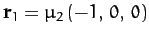 and
and
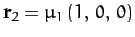 in our new coordinate system. Finally, let the position vector of
mass
in our new coordinate system. Finally, let the position vector of
mass  be
be
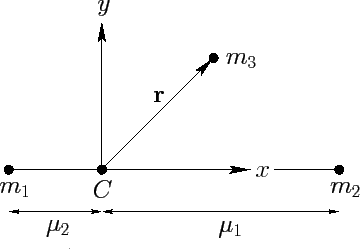
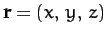 --see Figure 48.
Figure 48:
The co-rotating frame.
 |
According to Chapter 7, the equation of motion of mass in the rotating
reference frame takes the form
 |
(1050) |
where
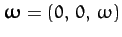 , and
, and
Here, the second term on the left-hand side of Equation (1050) is the Coriolis acceleration,
whereas the final term on the right-hand side is the centrifugal acceleration. The components of Equation (1050)
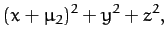
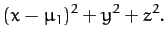
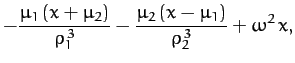
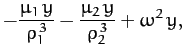
reduce to
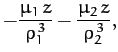
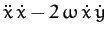
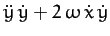
which yield
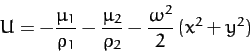
where
 |
(1059) |
is the sum of the gravitational and centrifugal potentials.
Now, it follows from Equations (1056)-(1058) that
Summing the above three equations, we obtain
![\begin{displaymath}
\frac{d}{dt}\left[\frac{1}{2}\left(\dot{x}^2+\dot{y}^2+\dot{z}^2\right) + U\right] = 0.
\end{displaymath}](img2555.png) |
(1063) |
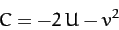
In other words,
 |
(1064) |
is a constant of the motion, where
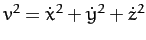 . In fact,
  is the
Jacobi integral introduced in Section 13.3 [it is easily demonstrated that Equations (1039) and
(1064) are identical].
Note, finally, that
the mass is restricted to regions in which
is the
Jacobi integral introduced in Section 13.3 [it is easily demonstrated that Equations (1039) and
(1064) are identical].
Note, finally, that
the mass is restricted to regions in which
 |
(1065) |
since  is a positive definite quantity.
Next: Lagrange Points
Up: The Three-Body Problem
Previous: Tisserand Criterion
Richard Fitzpatrick
2011-03-31